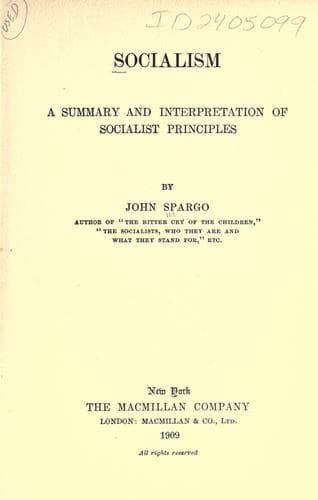
Socialism: A Summary and Interpretation of Socialist PrinciplesSpargo, John
History
Socialism: A Summary and Interpretation of Socialist Principles
Spargo, John
Socialism
What led Marx to launch out upon the troubled sea of economic science,
when all his predilections were for the study of pure philosophy, was
the fact that his philosophical studies had led him to a point whence
further progress seemed impossible, except by way of economics. The
Introduction to "A Contribution to the Critique of Political Economy"
makes this perfectly clear. Having decided that "the method of
production in material existence conditions social, political, and
mental evolution in general," a study of economics, and especially an
analysis of modern industrial society, became inevitable. During the
year 1845, when the theory of the economic interpretation of history was
absorbing his attention, Marx spent six weeks in England with his
friend Engels, and became acquainted with the work of the Ricardian
Socialists already referred to.[138] Engels had been living in England
about three years at this time, and had made an exhaustive investigation
of industrial conditions there, and become intimately acquainted with
the leaders of the Chartist movement. His fine library contained most of
the works of contemporary writers, and it was thus that Marx came to
know them.
Foremost of this school of Socialists which had arisen, quite naturally,
in the land where capitalism flourished at its best, were William
Godwin, Charles Hall, William Thompson, John Gray, Thomas Hodgskin, and
John Francis Bray. With the exception of Hall, of whose privately
printed book, "The Effects of Civilisation on the People of the European
States," 1805, he seems not to have known, Marx was familiar with the
writings of all the foregoing, and his obligations to some of them,
especially Thompson, Hodgskin, and Bray, were not slight. While the
charge, made by Dr. Anton Menger,[139] among others, that Marx took his
surplus value theory from Thompson is quite absurd, and rests, as
Bernstein has pointed out, upon nothing but the fact that Thompson used
the words "surplus value" frequently, but not at all in the same sense
as that in which Marx uses them,[140] we need not attempt to dispute the
fact that Marx gleaned much of value from Thompson and the two other
writers. While criticising them, and pointing out their shortcomings,
Marx himself frequently pays tributes of respect to each of them. His
indebtedness to any of them, or to all of them, consists simply in the
fact that he recognized the germinal truths in their writings, and saw
far beyond what they saw.
Public-domain text, read in full here on John Shaqi.
Reviews
Reviews
No reviews yet
Be the first to share your thoughts on this work.
Elsewhere in the archive
Join the Discussion
Join the discussion
Sign in to leave a comment or review.
Sign InorCreate an account