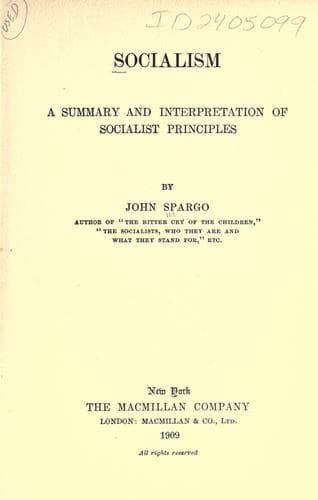
Socialism: A Summary and Interpretation of Socialist PrinciplesSpargo, John
History
Socialism: A Summary and Interpretation of Socialist Principles
Spargo, John
Socialism
This takes place all through industry. If the capitalist employs a
thousand workers under these conditions, each day he receives the
product of five thousand hours over and above the product actually paid
for. This constitutes his income. If the capitalist owned the land,
machinery, and raw materials, absolutely, without incumbrances of any
kind, the whole of that surplus-value would, naturally, belong to him.
But as a general rule this is not the case. He rents the land and must
pay rent to the landlord, or he works upon borrowed capital and must pay
interest upon loans, so that the surplus-value extracted from the
laborer must be divided into rent, interest, and profit. But how the
surplus-value is divided among landlords, moneylenders, creditors,
speculators, and actual employers is a matter of absolutely no moment to
the workers as a class. That is why such movements as that represented
by the followers of Henry George fail to vitally interest the working
class.[177] The division of the surplus-value wrung from the toil of the
workers gives rise to much quarrel and strife within the ranks of the
exploiting class, but the working class recognizes, and vaguely and
instinctively feels where it does not clearly recognize, that it has no
interest in these quarrels. All that interests it vitally is how to
lessen the extent of the exploitation to which it is subjected, and how
ultimately to end that exploitation altogether. That is the objective of
the movement for the socialization of the means of life.
Such, briefly stated, is the theory. We may illustrate it by the
following example: Let us say the average cost of a day's subsistence is
the product of five hours' social labor, which is represented by a wage
of $1 per day. In a factory there are 1000 workers. Their labor-power
they have sold at its exchange value, $1 per day per man, a total of
$1000. They use up $1000 worth of labor-power, then. They also use up
$1000 worth of raw material and wear out the plant to the extent of $100
in the course of their work. Now, instead of working five hours each,
that being the amount of time necessary to reproduce the value of their
wages, as above described, they all work ten hours. Thus, in place of
the $1000 they received as wages for the labor-_power_ they sold, they
create labor _products_, valued at just twice that sum, $2000. According
to our suppositions, therefore, the gross value of the day's product
will be $3100, the whole of it belonging to the capitalist, for the
simple and sufficient reason that he bought and paid for, at their full
value as commodities, all the elements entering into its production, the
machinery, materials, and labor-power. The capitalist pays,--
Public-domain text, read in full here on John Shaqi.
Reviews
Reviews
No reviews yet
Be the first to share your thoughts on this work.
Elsewhere in the archive
Join the Discussion
Join the discussion
Sign in to leave a comment or review.
Sign InorCreate an account