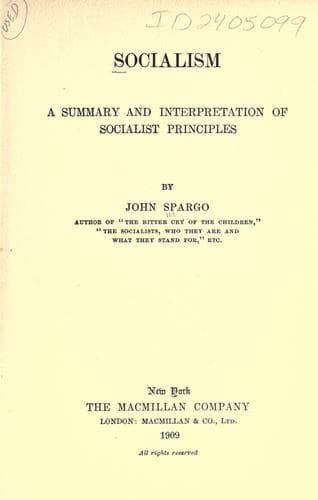
Socialism: A Summary and Interpretation of Socialist PrinciplesSpargo, John
History
Socialism: A Summary and Interpretation of Socialist Principles
Spargo, John
Socialism
The theory that profit is the wages of risk is answerable in
substantially the same way. It does not in any way explain the increase
in the aggregate wealth of the capitalist class to say that the
individual capitalist must have a chance to receive interest upon his
money in order to induce him to turn it into capital, to hazard losing
it wholly or in part. While the theory of risk helps to explain some
features of capitalism, the changes in the flow of capital into certain
forms of investment, and, to some small extent, the commercial crises
incidental thereto, it does not explain the vital problem, the source of
capitalist income. The chances of gain, as a premium for the risks
involved, explain satisfactorily enough the action of the gambler when
he enters into a game of roulette or faro. It cannot be said, however,
that the aggregate wealth of the gamblers is increased by playing
roulette or faro. Then, too, the risks of the laborers are vastly more
vital than those of the capitalist. Yet the premium for their risks of
health and life itself does not appear, unless, indeed, it be in their
wages, in which case the most superficial glance at our industrial
statistics will show that wages are by no means highest in those
occupations where the risks are greatest and most numerous. Further, the
wages of the risks for capitalists and laborers alike are drawn from the
same source, the product of the laborers' toil.
To consider, even briefly, all the varied theories of surplus-value
other than these would be a prolonged, dull, and profitless task. The
theory of abstinence, that profit is the just reward of the capitalist
for saving part of his wealth and using it as a means of production, is
answerable by _a priori_ arguments and by a vast volume of facts.
Abstinence obviously produces nothing; it can only save the wealth
already produced by labor, and no automatic increase of that saved-up
wealth is possible. If it is to increase without the labor of its owner,
it can only be through the exploitation of the labor of others, so that
the abstinence theory in no manner controverts the Marxian position. On
the other hand, we see that those whose wealth increases most rapidly
are not given to frugality or abstinence by any means. It may,
certainly, be possible for an individual to save enough by practicing
frugality and abstinence to enable him to invest in some profitable
enterprise, but the source of his profit is not his abstinence. That
must be sought elsewhere. Abstinence may provide him with the means for
taking the profit, but the profit itself must come from the value
created by human labor-power over and above its cost of production.
Public-domain text, read in full here on John Shaqi.
Reviews
Reviews
No reviews yet
Be the first to share your thoughts on this work.
Elsewhere in the archive
Join the Discussion
Join the discussion
Sign in to leave a comment or review.
Sign InorCreate an account