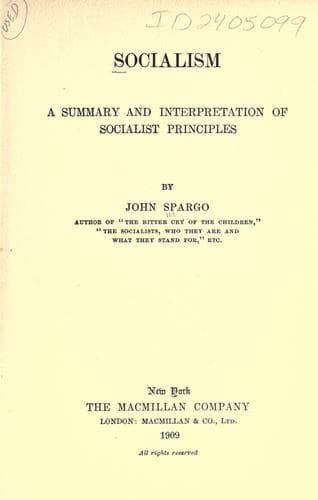
Socialism: A Summary and Interpretation of Socialist PrinciplesSpargo, John
History
Socialism: A Summary and Interpretation of Socialist Principles
Spargo, John
Socialism
From that spirit only vain dreams and fantastic vagaries can ever come.
What we must bear in mind is that the social fabric of to-morrow, like
that of yesterday, whose ruins we contemplate to-day, will not spring
up, complete, in response to our will, but will grow out of social
experience and needs.
II
One of the greatest and most lamentable errors in connection with the
propaganda of modern Socialism has been the assumption of its friends,
in many instances, and its foes, in most instances, that Socialism and
Individualism are entirely antithetical concepts. Infinite confusion has
been caused by setting the two against each other. Society consists of
an aggregation of individuals, but it is something more than that in
just the same sense as a house is something more than an aggregation of
bricks. It is an organism, though as yet an imperfectly developed one.
While the units of which it is composed have distinct and independent
lives within certain limits, they are, outside of those limits,
interdependent and inter-related. Man is governed by two great forces.
On the one hand, he is essentially an egoist, ever striving to attain
individual freedom; on the other hand, he is a social animal, ever
seeking association and avoiding isolation. This duality expresses
itself in the life of society. There is a struggle between its members
motived by the desire for individual expression and gain; and, alongside
of it, a sense of solidarity, a movement to mutual, reciprocal
relations, motived by the gregarian instinct. All social life is
necessarily an oscillation between these two motives. The social problem
in its last analysis is nothing more than the problem of combining and
harmonizing social and individual interests and actions springing
therefrom.
Public-domain text, read in full here on John Shaqi.
Reviews
Reviews
No reviews yet
Be the first to share your thoughts on this work.
Elsewhere in the archive
Join the Discussion
Join the discussion
Sign in to leave a comment or review.
Sign InorCreate an account