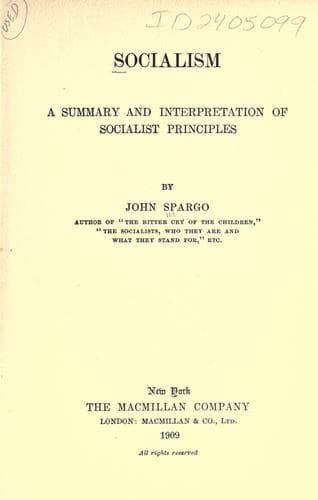
Socialism: A Summary and Interpretation of Socialist PrinciplesSpargo, John
History
Socialism: A Summary and Interpretation of Socialist Principles
Spargo, John
Socialism
It will help us to get rid of the difficulty presented by petty
industry and agriculture if we bear in mind that collective ownership is
not, as is commonly supposed, the supreme, fundamental condition of
Socialism. It is proposed only as a means to an end, not as the end
itself. The wealth producers are exploited by a class whose source of
income is the surplus-value extracted from the workers. Instinctively,
the workers struggle against that exploitation, to reduce the amount of
surplus-value taken by the capitalists to a minimum. To do away with
that exploitation social ownership and control is proposed. If the end
could be attained more speedily by other methods, those methods would be
adopted. It follows, therefore, that to make collective property of
things not used as a means of exploiting labor does not necessarily form
part of the Socialist programme. True, some such things might be
socialized in response to an urgent demand for efficiency, but, of
necessity, the struggle will be principally concerned with the
socializing of the means of production which are used as means of
exploitation by a class deriving its income from the surplus-value
produced by another class. It is easy enough to see that, according to
this principle of differentiation, it would be necessary to socialize
the railroad, but not at all necessary to socialize the wheelbarrow;
while it would be necessary to socialize a clothing factory, it would
not be necessary to take away a woman's domestic sewing machine.
Independent, self-employment, as in the case of a craftsman working in
his own shop with his own tools, or groups of workers working
cooeperatively, is quite consistent with Socialism.
In the Socialist state, then, certain forms of private industry will be
tolerated, and perhaps even definitely encouraged by the state, but the
great fundamental economic activities will be collectively managed. The
Socialist state will not be static and, consequently, what at first may
be regarded as being properly the subject of private enterprise may
develop to an extent or in directions which necessitate its
transformation to the category of essentially social properties. Hence,
it is not possible to give a list of things which would be socialized
and another list of things which would remain private property, but
perfectly possible to state the principle which must be the chief
determinant of the extent of socialization. With this principle in mind
it is fairly possible to sketch the outlines at least of the economic
development of the collectivist commonwealth; the conditions essential
to that stage of social evolution at which it will be possible and
natural to speak of capitalism as a past and outgrown stage, and of the
present as the era of Socialism.
Public-domain text, read in full here on John Shaqi.
Reviews
Reviews
No reviews yet
Be the first to share your thoughts on this work.
Elsewhere in the archive
Join the Discussion
Join the discussion
Sign in to leave a comment or review.
Sign InorCreate an account