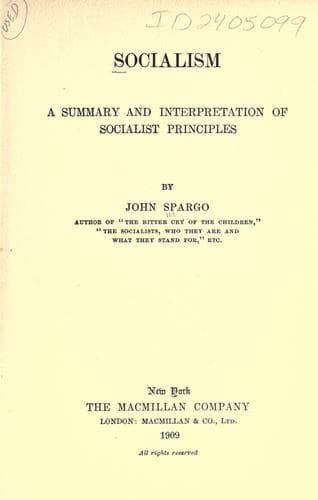
Socialism: A Summary and Interpretation of Socialist PrinciplesSpargo, John
History
Socialism: A Summary and Interpretation of Socialist Principles
Spargo, John
Socialism
As owner of the earth and all the major instruments of production and
exchange, society would occupy a position which would enable it to
insure that the physical and mental benefits derived from its wealth,
its natural resources, its collective experience, genius, and labor,
were universalized as befits a democracy. It would be able to guarantee
to all its citizens the right to labor, through preventing private or
class monopolization of the land and instruments of production and
social opportunities in general. It would be in a position to make every
development from competition to monopoly the occasion for further
socialization. Thus there would be no danger to the state in permitting,
or even fostering, private industry within the limits described. As the
organizer of the vast body of labor essential to the operation of the
main productive and distributive functions of society, and to the other
public services, the state would automatically, so to speak, set the
standards of income and leisure which private industry would be
compelled, by competitive force, to observe. The regulation of
production, too, would be possible, and as a result the crises arising
from glutted markets would disappear. Finally, in the control of all the
functions of credit, the state would effectually prevent the
exploitation of the mass of the people through financial agencies, one
of the greatest evils of our present system.
The application of the principles of democracy to the organization and
administration of these great economic services of production, exchange,
and credit is a problem full of alluring invitations to speculation.
"This that they call the Organization of Labor," said Carlyle, "is the
Universal Vital Problem of the World." This description applies not to
what we commonly mean by the "organization of labor," namely, the
organization of the laborers in unions for class conflict, but to the
organization of the brain and muscle of the world to secure the greatest
efficiency. This is the great central problem of the socialization of
industry and the state, before which all other problems pale into
insignificance. It is comparatively easy to picture an ideal political
democracy; and the main structural economic organization of the
Socialist regime, with its private and public functions more or less
clearly defined, is not very difficult of conception. These are
foreshadowed with varying degrees of distinctness in present society,
and the light of experience illumines the pathway before us. It is when
we come to the methods of organization and management, the _spirit_ of
the economic organization of the future state, that the light fails and
we must grope our way into the great unknown with imagination and our
sense of justice for guides.
Public-domain text, read in full here on John Shaqi.
Reviews
Reviews
No reviews yet
Be the first to share your thoughts on this work.
Elsewhere in the archive
Join the Discussion
Join the discussion
Sign in to leave a comment or review.
Sign InorCreate an account