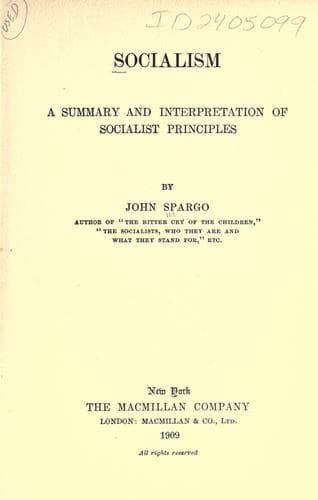
Socialism: A Summary and Interpretation of Socialist PrinciplesSpargo, John
History
Socialism: A Summary and Interpretation of Socialist Principles
Spargo, John
Socialism
And here we are not wholly left to our imaginations, not wholly without
experience to guide us. In actual practice to-day, in those industries
in which the organization of the workers into unions has been most
successful, the workers, through their organizations, do exercise a
certain amount of control over the conditions of their employment. Their
right to share in the determination of the conditions of labor is
conceded. They make trade agreements, for instance, in which such
matters as wages, hours of labor, apprenticeship, output, engagement and
discharge of workers, and numerous other matters, are provided for and
made subject to the joint control of the workers and their employers. Of
course, this share in the control of the industry in which they are
employed is a right enjoyed only as a fruit of conquest, won by war and
maintained by ceaseless vigilance and armed strength. It is not
inconceivable that in the Socialist state there might be a frank
extension of this principle. The workers in the main groups of
industries might form autonomous organizations for the administration of
their special interests, subject only to certain fundamental laws of the
state. Thus the trade unions of to-day would evolve into administrative
politico-economic organizations, after the manner of the mediaeval
guilds, and become constructive agencies in society instead of mere
agencies of class warfare as at present.
The economic organization of the Socialist state would consist, then, of
three distinct divisions, as follows: (1) Private production and
exchange, subject only to such general supervision and control by the
state as the interests of society demand, such as protection against
monopolization, sanitary laws, and the like; (2) voluntary cooeperation,
subject to similar supervision and control; (3) production and
distribution by the state, the administration to be by the autonomous
organizations of the workers in industrial groups, subject to the
fundamental laws and government of society as a whole.[190]
VI
Public-domain text, read in full here on John Shaqi.
Reviews
Reviews
No reviews yet
Be the first to share your thoughts on this work.
Elsewhere in the archive
Join the Discussion
Join the discussion
Sign in to leave a comment or review.
Sign InorCreate an account