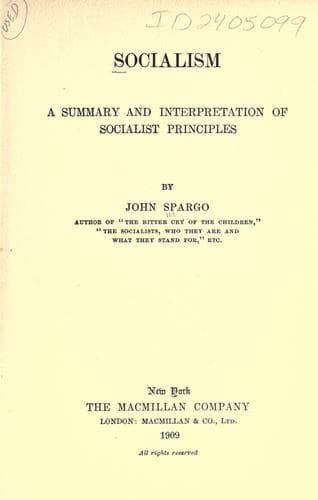
Socialism: A Summary and Interpretation of Socialist PrinciplesSpargo, John
History
Socialism: A Summary and Interpretation of Socialist Principles
Spargo, John
Socialism
normal times. Recognition of this fact effectually destroys much
criticism of the theory.
The interest of the wage-worker, as wage-worker, is to receive the
largest wage possible for the least number of hours spent in labor. The
interest of the employer, as employer, on the other hand, is to secure
from the worker as many hours of service, as much labor power, as
possible for the lowest wage which the worker can be induced to accept.
The workers employed in a factory may be divided by a hundred different
forces. They may be divided by racial differences, for instance; but
while preserving these differences in a large measure, they will tend to
unite upon the basis of their economic interests. Some of the great
labor unions, notably the United Mine Workers,[118] afford remarkable
illustrations of this fact. If the difference of religious interests
leads to division, the same unanimity of economic interests will sooner
or later be developed. No impartial investigator who studies the
influence of a great labor union which includes in its membership
workers of various nationalities and adherents of various religious
creeds, can fail to observe the fact that the community of economic
interests which unites them is a powerful factor making for their
amalgamation into a harmonious civic whole.
With the employers it is the same. They, too, may be divided by a
hundred forces; the competition among them may be keen and fierce, but
common economic interests will tend to unite them against the
organizations of the workers they employ. Racial, religious, social, and
other divisions and distinctions, may be maintained, but they will, in
general, unite for the protection and furtherance of their common
economic interests.
So much, indeed, belongs to the very primer stage of economic theory.
Adam Smith is rather out of fashion nowadays, but there is still much in
"The Wealth of Nations" which will repay our attention. No Socialist
writer, not even Marx, has stated the fundamental principle of the
antagonism between the employing and employed classes more clearly, as
witness the following:--
Public-domain text, read in full here on John Shaqi.
Reviews
Reviews
No reviews yet
Be the first to share your thoughts on this work.
Elsewhere in the archive
Join the Discussion
Join the discussion
Sign in to leave a comment or review.
Sign InorCreate an account