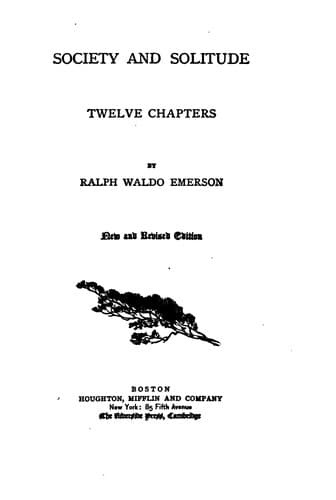
Society and solitude: Twelve chaptersEmerson, Ralph Waldo
Philosophy
Society and solitude: Twelve chapters
Emerson, Ralph Waldo
American essays -- 19th century
2. Practical power. Men admire the man who can organize their wishes
and thoughts in stone and wood and steel and brass,--the man who can
build the boat, who has the impiety to make the rivers run the way
he wants them, who can lead his telegraph through the ocean from
shore to shore; who, sitting in his closet, can lay out the plans of
a campaign,--sea-war and land-war; such that the best generals and
admirals, when all is done, see that they must thank him for success;
the power of better combination and foresight, however exhibited,
which, whether it only plays a game of chess, or whether, more loftily,
a cunning mathematician, penetrating the cubic weights of stars,
predicts the planet which eyes had never seen; or whether, exploring
the chemical elements whereof we and the world are made, and seeing
their secret, Franklin draws off the lightning in his hand, suggesting
that one day a wiser geology shall make the earthquake harmless and
the volcano an agricultural resource. Or here is one who, seeing the
wishes of men, knows how to come at their end; whispers to this friend,
argues down that adversary, moulds society to his purpose, and looks at
all men as wax for his hands,--takes command of them as the wind does
of clouds, as the mother does of the child, or the man that knows more
does of the man that knows less; and leads them in glad surprise to the
very point where they would be: this man is followed with acclamation.
3. The third excellence is courage, the perfect will, which no terrors
can shake, which is attracted by frowns or threats or hostile armies,
nay, needs these to awake and fan its reserved energies into a pure
flame, and is never quite itself until the hazard is extreme; then
it is serene and fertile, and all its powers play well. There is a
Hercules, an Achilles, a Rustem, an Arthur, or a Cid in the mythology
of every nation; and in authentic history, a Leonidas, a Scipio, a
Cæsar, a Richard Cœur de Lion, a Cromwell, a Nelson, a Great Condé, a
Bertrand du Guesclin, a Doge Dandolo, a Napoleon, a Massena, and Ney.
’Tis said courage is common, but the immense esteem in which it is
held proves it to be rare. Animal resistance, the instinct of the male
animal when cornered, is no doubt common; but the pure article, courage
with eyes, courage with conduct, self-possession at the cannon’s mouth,
cheerfulness in lonely adherence to the right, is the endowment of
elevated characters. I need not show how much it is esteemed, for the
people give it the first rank. They forgive everything to it. What an
ado we make through two thousand years about Thermopylæ and Salamis!
What a memory of Poitiers and Crecy, and Bunker Hill, and Washington’s
endurance! And any man who puts his life in peril in a cause which
is esteemed becomes the darling of all men. The very nursery-books,
the ballads which delight boys, the romances which delight men, the
favorite topics of eloquence, the thunderous emphasis which orators
Public-domain text, read in full here on John Shaqi.
Reviews
Reviews
No reviews yet
Be the first to share your thoughts on this work.
Elsewhere in the archive
Join the Discussion
Join the discussion
Sign in to leave a comment or review.
Sign InorCreate an account