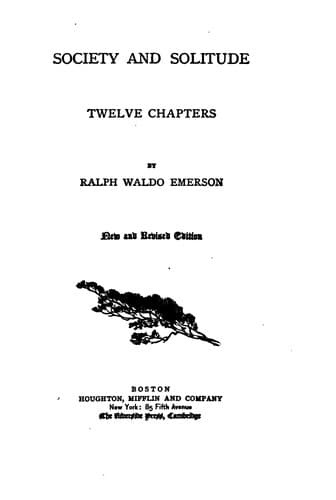
Society and solitude: Twelve chaptersEmerson, Ralph Waldo
Philosophy
Society and solitude: Twelve chapters
Emerson, Ralph Waldo
American essays -- 19th century
Knowledge is the antidote to fear,--Knowledge, Use, and Reason, with
its higher aids. The child is as much in danger from a staircase,
or the fire-grate, or a bath-tub, or a cat, as the soldier from a
cannon or an ambush. Each surmounts the fear as fast as he precisely
understands the peril, and learns the means of resistance. Each is
liable to panic, which is, exactly, the terror of ignorance surrendered
to the imagination. Knowledge is the encourager, knowledge that takes
fear out of the heart, knowledge and use, which is knowledge in
practice. They can conquer who believe they can. It is he who has done
the deed once who does not shrink from attempting it again. It is the
groom who knows the jumping horse well who can safely ride him. It is
the veteran soldier, who, seeing the flash of the cannon, can step
aside from the path of the ball. Use makes a better soldier than the
most urgent considerations of duty,--familiarity with danger enabling
him to estimate the danger. He sees how much is the risk, and is not
afflicted with imagination; knows practically Marshal Saxe’s rule, that
every soldier killed costs the enemy his weight in lead.
The sailor loses fear as fast as he acquires command of sails and
spars and steam; the frontiersman, when he has a perfect rifle and has
acquired a sure aim. To the sailor’s experience every new circumstance
suggests what he must do. The terrific chances which make the hours
and the minutes long to the passenger, he whiles away by incessant
application of expedients and repairs. To him a leak, a hurricane, or
a water-spout is so much work--no more. The hunter is not alarmed by
bears, catamounts, or wolves, nor the grazier by his bull, nor the
dog-breeder by his bloodhound, nor an Arab by the simoom, nor a farmer
by a fire in the woods. The forest on fire looks discouraging enough
to a citizen: the farmer is skilful to fight it. The neighbors run
together; with pine boughs they can mop out the flame, and, by raking
with the hoe a long but little trench, confine to a patch the fire
which would easily spread over a hundred acres.
In short, courage consists in equality to the problem before us. The
school-boy is daunted before his tutor by a question of arithmetic,
because he does not yet command the simple steps of the solution which
the boy beside him has mastered. These once seen, he is as cool as
Archimedes, and cheerily proceeds a step farther. Courage is equality
to the problem, in affairs, in science, in trade, in council, or in
action; consists in the conviction that the agents with whom you
contend are not superior in strength or resources or spirit to you.
The general must stimulate the mind of his soldiers to the perception
that they are men, and the enemy is no more. Knowledge, yes; for the
danger of dangers is illusion. The eye is easily daunted; and the
drums, flags, shining helmets, beard, and mustache of the soldier have
conquered you long before his sword or bayonet reaches you.
Public-domain text, read in full here on John Shaqi.
Reviews
Reviews
No reviews yet
Be the first to share your thoughts on this work.
Elsewhere in the archive
Join the Discussion
Join the discussion
Sign in to leave a comment or review.
Sign InorCreate an account