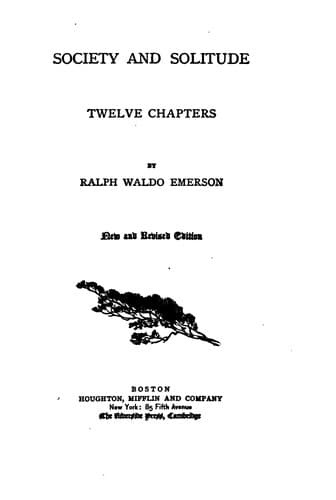
Society and solitude: Twelve chaptersEmerson, Ralph Waldo
Philosophy
Society and solitude: Twelve chapters
Emerson, Ralph Waldo
American essays -- 19th century
It gives the cutting edge to every profession. The judge puts his
mind to the tangle of contradictions in the case, squarely accosts
the question, and, by not being afraid of it, by dealing with it as
business which must be disposed of, he sees presently that common
arithmetic and common methods apply to this affair. Perseverance
strips it of all peculiarity, and ranges it on the same ground as
other business. Morphy played a daring game in chess: the daring was
only an illusion of the spectator, for the player sees his move to be
well fortified and safe. You may see the same dealing in criticism;
a new book astonishes for a few days, takes itself out of common
jurisdiction, and nobody knows what to say of it: but the scholar is
not deceived. The old principles which books exist to express are more
beautiful than any book; and out of love of the reality he is an expert
judge how far the book has approached it and where it has come short.
In all applications ’tis the same power,--the habit of reference to
one’s own mind, as the home of all truth and counsel, and which can
easily dispose of any book because it can very well do without all
books. When a confident man comes into a company magnifying this or
that author he has freshly read, the company grow silent and ashamed of
their ignorance. But I remember the old professor, whose searching mind
engraved every word he spoke on the memory of the class, when we asked
if he had read this or that shining novelty, “No, I have never read
that book”; instantly the book lost credit, and was not to be heard of
again.
Every creature has a courage of his constitution fit for his
duties:--Archimedes, the courage of a geometer to stick to his diagram,
heedless of the siege and sack of the city; and the Roman soldier his
faculty to strike at Archimedes. Each is strong, relying on his own,
and each is betrayed when he seeks in himself the courage of others.
Captain John Brown, the hero of Kansas, said to me in conversation,
that “for a settler in a new country, one good, believing,
strong-minded man is worth a hundred, nay, a thousand men without
character; and that the right men will give a permanent direction to
the fortunes of a state. As for the bullying drunkards, of which armies
are usually made up, he thought cholera, small-pox, and consumption as
valuable recruits.” He held the belief that courage and chastity are
silent concerning themselves. He said, “As soon as I hear one of my men
say, ‘Ah, let me only get my eye on such a man, I’ll bring him down,’
I don’t expect much aid in the fight from that talker. ’Tis the quiet,
peaceable men, the men of principle, that make the best soldiers.”
“’Tis still observed those men most valiant are
Who are most modest ere they came to war.”
True courage is not ostentatious; men who wish to inspire terror seem
thereby to confess themselves cowards. Why do they rely on it, but
because they know how potent it is with themselves?
Public-domain text, read in full here on John Shaqi.
Reviews
Reviews
No reviews yet
Be the first to share your thoughts on this work.
Elsewhere in the archive
Join the Discussion
Join the discussion
Sign in to leave a comment or review.
Sign InorCreate an account