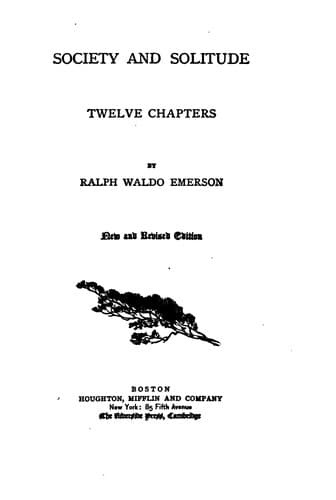
Society and solitude: Twelve chaptersEmerson, Ralph Waldo
Philosophy
Society and solitude: Twelve chapters
Emerson, Ralph Waldo
American essays -- 19th century
There is a persuasion in the soul of man that he is here for cause,
that he was put down in this place by the Creator to do the work for
which he inspires him, that thus he is an overmatch for all antagonists
that could combine against him. The pious Mrs. Hutchinson says of some
passages in the defence of Nottingham against the Cavaliers, “It was a
great instruction that the best and highest courages are beams of the
Almighty.” And whenever the religious sentiment is adequately affirmed,
it must be with dazzling courage. As long as it is cowardly insinuated,
as with the wish to succor some partial and temporary interest, or to
make it affirm some pragmatical tenet which our parish church receives
to-day, it is not imparted, and cannot inspire or create. For it is
always new, leads and surprises, and practice never comes up with it.
There are ever appearing in the world men who, almost as soon as they
are born, take a bee-line to the rack of the inquisitor, the axe of the
tyrant, like Jordano Bruno, Vanini, Huss, Paul, Jesus, and Socrates.
Look at Fox’s Lives of the Martyrs, Sewel’s History of the Quakers,
Southey’s Book of the Church, at the folios of the Brothers Bollandi,
who collected the lives of twenty-five thousand martyrs, confessors,
ascetics, and self-tormentors. There is much of fable, but a broad
basis of fact. The tender skin does not shrink from bayonets, the timid
woman is not scared by fagots; the rack is not frightful, nor the rope
ignominious. The poor Puritan, Antony Parsons, at the stake, tied straw
on his head, when the fire approached him, and said, “This is God’s
hat.” Sacred courage indicates that a man loves an idea better than all
things in the world; that he is aiming neither at pelf or comfort, but
will venture all to put in act the invisible thought in his mind. He
is everywhere a liberator, but of a freedom that is ideal; not seeking
to have land or money or conveniences, but to have no other limitation
than that which his own constitution imposes. He is free to speak
truth; he is not free to lie. He wishes to break every yoke all over
the world which hinders his brother from acting after his thought.
There are degrees of courage, and each step upward makes us acquainted
with a higher virtue. Let us say then frankly that the education of
the will is the object of our existence. Poverty, the prison, the
rack, the fire, the hatred and execrations of our fellow-men, appear
trials beyond the endurance of common humanity; but to the hero whose
intellect is aggrandized by the soul, and so measures these penalties
against the good which his thought surveys, these terrors vanish as
darkness at sunrise.
Public-domain text, read in full here on John Shaqi.
Reviews
Reviews
No reviews yet
Be the first to share your thoughts on this work.
Elsewhere in the archive
Join the Discussion
Join the discussion
Sign in to leave a comment or review.
Sign InorCreate an account