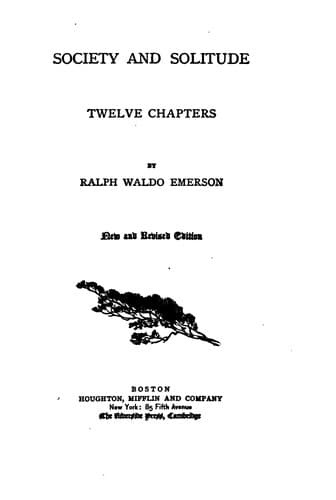
Society and solitude: Twelve chaptersEmerson, Ralph Waldo
Philosophy
Society and solitude: Twelve chapters
Emerson, Ralph Waldo
American essays -- 19th century
I count it another capital advantage of age, this, that a success more
or less signifies nothing. Little by little, it has amassed such a
fund of merit, that it can very well afford to go on its credit when
it will. When I chanced to meet the poet Wordsworth, then sixty-three
years old, he told me, “that he had just had a fall and lost a tooth,
and, when his companions were much concerned for the mischance, he had
replied, that he was glad it had not happened forty years before.”
Well, Nature takes care that we shall not lose our organs forty years
too soon. A lawyer argued a cause yesterday in the Supreme Court, and
I was struck with a certain air of levity and defiance which vastly
became him. Thirty years ago it was a serious concern to him whether
his pleading was good and effective. Now it is of importance to his
client, but of none to himself. It has been long already fixed what he
can do and cannot do, and his reputation does not gain or suffer from
one or a dozen new performances. If he should, on a new occasion, rise
quite beyond his mark, and achieve somewhat great and extraordinary,
that, of course, would instantly tell; but he may go below his mark
with impunity, and people will say, ‘O, he had headache,’ or, ‘He lost
his sleep for two nights.’ What a lust of appearance, what a load of
anxieties that once degraded him, he is thus rid of! Every one is
sensible of this cumulative advantage in living. All the good days
behind him are sponsors, who speak for him when he is silent, pay for
him when he has no money, introduce him where he has no letters, and
work for him when he sleeps.
Public-domain text, read in full here on John Shaqi.
Reviews
Reviews
No reviews yet
Be the first to share your thoughts on this work.
Elsewhere in the archive
Join the Discussion
Join the discussion
Sign in to leave a comment or review.
Sign InorCreate an account