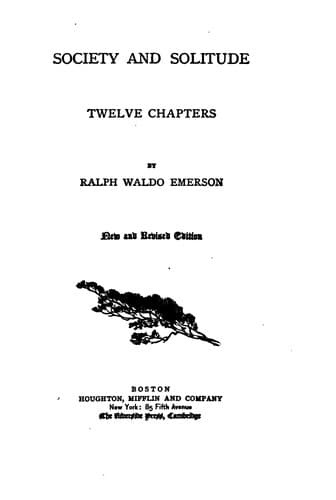
Society and solitude: Twelve chaptersEmerson, Ralph Waldo
Philosophy
Society and solitude: Twelve chapters
Emerson, Ralph Waldo
American essays -- 19th century
For a fourth benefit, age sets its house in order, and finishes its
works, which to every artist is a supreme pleasure. Youth has an excess
of sensibility, before which every object glitters and attracts. We
leave one pursuit for another, and the young man’s year is a heap of
beginnings. At the end of a twelvemonth, he has nothing to show for
it,--not one completed work. But the time is not lost. Our instincts
drove us to hive innumerable experiences, that are yet of no visible
value, and which we may keep for twice seven years before they shall
be wanted. The best things are of secular growth. The instinct of
classifying marks the wise and healthy mind. Linnæus projects his
system, and lays out his twenty-four classes of plants, before yet he
has found in Nature a single plant to justify certain of his classes.
His seventh class has not one. In process of time, he finds with
delight the little white _Trientalis_, the only plant with seven petals
and sometimes seven stamens, which constitutes a seventh class in
conformity with his system. The conchologist builds his cabinet whilst
as yet he has few shells. He labels shelves for classes, cells for
species: all but a few are empty. But every year fills some blanks, and
with accelerating speed as he becomes knowing and known. An old scholar
finds keen delight in verifying the impressive anecdotes and citations
he has met with in miscellaneous reading and hearing, in all the years
of youth. We carry in memory important anecdotes, and have lost all
clew to the author from whom we had them. We have a heroic speech from
Rome or Greece, but cannot fix it on the man who said it. We have an
admirable line worthy of Horace, ever and anon resounding in our mind’s
ear, but have searched all probable and improbable books for it in
vain. We consult the reading men: but, strangely enough, they who know
everything know not this. But especially we have a certain insulated
thought, which haunts us, but remains insulated and barren. Well,
there is nothing for all this but patience and time. Time, yes, that
is the finder, the unweariable explorer, not subject to casualties,
omniscient at last. The day comes when the hidden author of our story
is found; when the brave speech returns straight to the hero who
said it; when the admirable verse finds the poet to whom it belongs;
and best of all, when the lonely thought, which seemed so wise, yet
half-wise, half-thought, because it cast no light abroad, is suddenly
matched in our mind by its twin, by its sequence, or next related
analogy, which gives it instantly radiating power, and justifies the
superstitious instinct with which we have hoarded it. We remember our
old Greek Professor at Cambridge, an ancient bachelor, amid his folios,
possessed by this hope of completing a task, with nothing to break his
leisure after the three hours of his daily classes, yet ever restlessly
stroking his leg, and assuring himself “he should retire from the
Public-domain text, read in full here on John Shaqi.
Reviews
Reviews
No reviews yet
Be the first to share your thoughts on this work.
Elsewhere in the archive
Join the Discussion
Join the discussion
Sign in to leave a comment or review.
Sign InorCreate an account