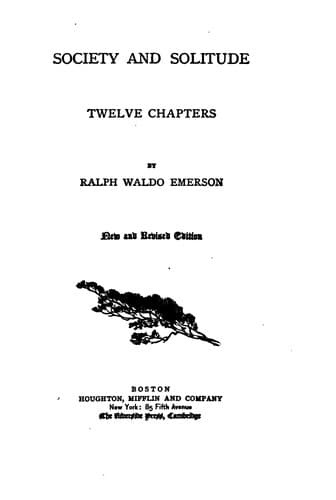
Society and solitude: Twelve chaptersEmerson, Ralph Waldo
Philosophy
Society and solitude: Twelve chapters
Emerson, Ralph Waldo
American essays -- 19th century
the same popularity continued.--“Not the same fury,” he said, “not
the same wild enthusiasm as before, but a greater esteem, as he
became more known. He did not terrify, but was admired.”
We spent about an hour in his room. He speaks very distinctly for so
old a man, enters bravely into long sentences, which are interrupted by
want of breath, but carries them invariably to a conclusion, without
correcting a word.
He spoke of the new novels of Cooper, and “Peep at the Pilgrims,”
and “Saratoga,” with praise, and named with accuracy the characters
in them. He likes to have a person always reading to him, or company
talking in his room, and is better the next day after having visitors
in his chamber from morning to night.
He received a premature report of his son’s election, on Sunday
afternoon, without any excitement, and told the reporter he had
been hoaxed, for it was not yet time for any news to arrive. The
informer, something damped in his heart, insisted on repairing to the
meeting-house, and proclaimed it aloud to the congregation, who were
so overjoyed that they rose in their seats and cheered thrice. The
Reverend Mr. Whitney dismissed them immediately.
* * * * *
When life has been well spent, age is a loss of what it can well
spare,--muscular strength, organic instincts, gross bulk, and works
that belong to these. But the central wisdom, which was old in infancy,
is young in fourscore years, and, dropping off obstructions, leaves in
happy subjects the mind purified and wise. I have heard that whoever
loves is in no condition old. I have heard, that, whenever the name of
man is spoken, the doctrine of immortality is announced; it cleaves
to his constitution. The mode of it baffles our wit, and no whisper
comes to us from the other side. But the inference from the working
of intellect, hiving knowledge, hiving skill,--at the end of life just
ready to be born,--affirms the inspirations of affection and of the
moral sentiment.
THE END.
Cambridge: Printed by Welch, Bigelow, and Company.
FOOTNOTES:
[A] Dr. Thomas Brown.
[B] Iliad, III. 191.
[C] Diary, I. 169.
TRANSCRIBER’S NOTES:
Italicized text is surrounded by underscores: _italics_.
Obvious typographical errors have been corrected.
Inconsistencies in hyphenation have been standardized.
Archaic or variant spelling has been retained.
The cover image for this eBook was created by the transcriber using
the original cover and is entered into the public domain.
Public-domain text, read in full here on John Shaqi.
Reviews
Reviews
No reviews yet
Be the first to share your thoughts on this work.
Elsewhere in the archive
Join the Discussion
Join the discussion
Sign in to leave a comment or review.
Sign InorCreate an account