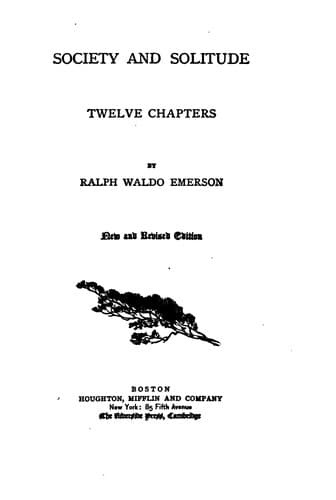
Society and solitude: Twelve chaptersEmerson, Ralph Waldo
Philosophy
Society and solitude: Twelve chapters
Emerson, Ralph Waldo
American essays -- 19th century
bring them again together? What is the hoop that holds them stanch?
It is the iron band of poverty, of necessity, of austerity, which,
excluding them from the sensual enjoyments which make other boys too
early old, has directed their activity in safe and right channels, and
made them, despite themselves, reverers of the grand, the beautiful,
and the good. Ah! short-sighted students of books, of Nature, and of
man! too happy, could they know their advantages. They pine for freedom
from that mild parental yoke; they sigh for fine clothes, for rides,
for the theatre, and premature freedom and dissipation, which others
possess. Woe to them, if their wishes were crowned! The angels that
dwell with them, and are weaving laurels of life for their youthful
brows, are Toil, and Want, and Truth, and Mutual Faith.
In many parts of true economy a cheering lesson may be learned from the
mode of life and manners of the later Romans, as described to us in
the letters of the younger Pliny. Nor can I resist the temptation of
quoting so trite an instance as the noble housekeeping of Lord Falkland
in Clarendon: “His house being within little more than ten miles from
Oxford, he contracted familiarity and friendship with the most polite
and accurate men of that University, who found such an immenseness of
wit, and such a solidity of judgment in him, so infinite a fancy, bound
in by a most logical ratiocination, such a vast knowledge that he was
not ignorant in anything, yet such an excessive humility, as if he had
known nothing, that they frequently resorted and dwelt with him, as in
a college situated in a purer air; so that his house was a university
in a less volume, whither they came, not so much for repose as study,
and to examine and refine those grosser propositions which laziness
and consent made current in vulgar conversation.”
I honor that man whose ambition it is, not to win laurels in the state
or the army, not to be a jurist or a naturalist, not to be a poet or
a commander, but to be a master of living well, and to administer
the offices of master or servant, of husband, father, and friend.
But it requires as much breadth of power for this as for those other
functions,--as much, or more,--and the reason for the failure is the
same. I think the vice of our housekeeping is, that it does not hold
man sacred. The vice of government, the vice of education, the vice of
religion, is one with that of private life.
Public-domain text, read in full here on John Shaqi.
Reviews
Reviews
No reviews yet
Be the first to share your thoughts on this work.
Join the Discussion
Join the discussion
Sign in to leave a comment or review.
Sign InorCreate an account