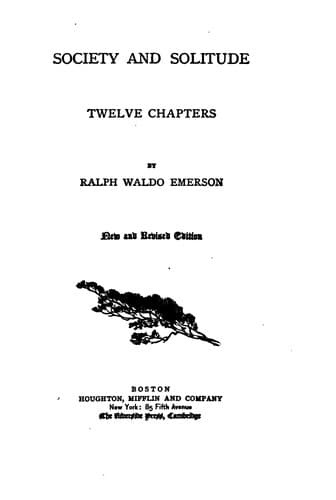
Society and solitude: Twelve chaptersEmerson, Ralph Waldo
Philosophy
Society and solitude: Twelve chapters
Emerson, Ralph Waldo
American essays -- 19th century
In the old fables, we used to read of a cloak brought from fairy-land
as a gift for the fairest and purest in Prince Arthur’s court. It was
to be her prize whom it would fit. Every one was eager to try it on,
but it would fit nobody: for one it was a world too wide, for the next
it dragged on the ground, and for the third it shrunk to a scarf. They,
of course, said that the devil was in the mantle, for really the truth
was in the mantle, and was exposing the ugliness which each would fain
conceal. All drew back with terror from the garment. The innocent
Genelas alone could wear it. In like manner, every man is provided in
his thought with a measure of man which he applies to every passenger.
Unhappily, not one in many thousands comes up to the stature and
proportions of the model. Neither does the measurer himself; neither
do the people in the street; neither do the select individuals whom he
admires,--the heroes of the race. When he inspects them critically, he
discovers that their aims are low, that they are too quickly satisfied.
He observes the swiftness with which life culminates, and the humility
of the expectations of the greatest part of men. To each occurs, soon
after the age of puberty, some event, or society, or way of living,
which becomes the crisis of life, and the chief fact in their history.
In woman, it is love and marriage (which is more reasonable); and
yet it is pitiful to date and measure all the facts and sequel of an
unfolding life from such a youthful, and generally inconsiderate,
period as the age of courtship and marriage. In men, it is their place
of education, choice of an employment, settlement in a town, or removal
to the East or to the West, or some other magnified trifle, which makes
the meridian moment, and all the after years and actions only derive
interest from their relation to that. Hence it comes that we soon catch
the trick of each man’s conversation, and, knowing his two or three
main facts, anticipate what he thinks of each new topic that rises. It
is scarcely less perceivable in educated men, so called, than in the
uneducated. I have seen finely endowed men at college festivals, ten,
twenty years after they had left the halls, returning, as it seemed,
the same boys who went away. The same jokes pleased, the same straws
tickled; the manhood and offices they brought thither at this return
seemed mere ornamental masks: underneath they were boys yet. We never
come to be citizens of the world, but are still villagers, who think
that everything in their petty town is a little superior to the same
thing anywhere else. In each the circumstance signalized differs, but
in each it is made the coals of an ever-burning egotism. In one, it was
his going to sea; in a second, the difficulties he combated in going to
college; in a third, his journey to the West, or his voyage to Canton;
in a fourth, his coming out of the Quaker Society; in a fifth, his
Public-domain text, read in full here on John Shaqi.
Reviews
Reviews
No reviews yet
Be the first to share your thoughts on this work.
Join the Discussion
Join the discussion
Sign in to leave a comment or review.
Sign InorCreate an account