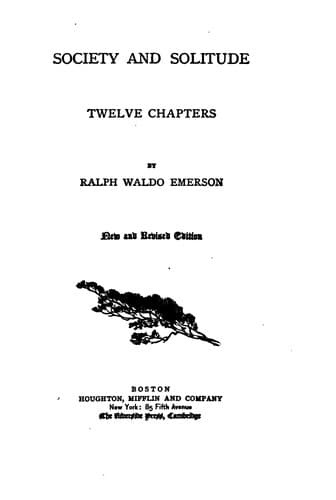
Society and solitude: Twelve chaptersEmerson, Ralph Waldo
Philosophy
Society and solitude: Twelve chapters
Emerson, Ralph Waldo
American essays -- 19th century
Whilst thus nature and the hints we draw from man suggest a true and
lofty life, a household equal to the beauty and grandeur of this world,
especially we learn the same lesson from those best relations to
individual men which the heart is always prompting us to form. Happy
will that house be in which the relations are formed from character,
after the highest, and not after the lowest order; the house in which
character marries, and not confusion and a miscellany of unavowable
motives. Then shall marriage be a covenant to secure to either party
the sweetness and honor of being a calm, continuing, inevitable
benefactor to the other. Yes, and the sufficient reply to the sceptic
who doubts the competence of man to elevate and to be elevated is in
that desire and power to stand in joyful and ennobling intercourse with
individuals, which makes the faith and the practice of all reasonable
men.
The ornament of a house is the friends who frequent it. There is no
event greater in life than the appearance of new persons about our
hearth, except it be the progress of the character which draws them.
It has been finely added by Landor to his definition of the _great
man_, “It is he who can call together the most select company when it
pleases him.” A verse of the old Greek Menander remains, which runs in
translation:--
“Not on the store of sprightly wine,
Nor plenty of delicious meats,
Though generous Nature did design
To court us with perpetual treats,--
’Tis not on these we for content depend,
So much as on the shadow of a Friend.”
It is the happiness which, where it is truly known, postpones all other
satisfactions, and makes politics and commerce and churches cheap. For
we figure to ourselves,--do we not?--that when men shall meet as they
should, as states meet,--each a benefactor, a shower of falling stars,
so rich with deeds, with thoughts, with so much accomplishment,--it
shall be the festival of nature, which all things symbolize; and
perhaps Love is only the highest symbol of Friendship, as all other
things seem symbols of love. In the progress of each man’s character,
his relations to the best men, which at first seem only the romances of
youth, acquire a graver importance; and he will have learned the lesson
of life who is skilful in the ethics of friendship.
Beyond its primary ends of the conjugal, parental, and amicable
relations, the household should cherish the beautiful arts and the
sentiment of veneration.
* * * * *
Public-domain text, read in full here on John Shaqi.
Reviews
Reviews
No reviews yet
Be the first to share your thoughts on this work.
Elsewhere in the archive
Join the Discussion
Join the discussion
Sign in to leave a comment or review.
Sign InorCreate an account