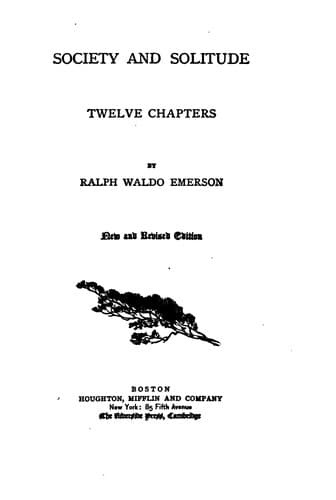
Society and solitude: Twelve chaptersEmerson, Ralph Waldo
Philosophy
Society and solitude: Twelve chapters
Emerson, Ralph Waldo
American essays -- 19th century
new diet and regimen; in a sixth, his coming forth from the abolition
organizations; and in a seventh, his going into them. It is a life of
toys and trinkets. We are too easily pleased.
I think this sad result appears in the manners. The men we see in each
other do not give us the image and likeness of man. The men we see are
whipped through the world; they are harried, wrinkled, anxious; they
all seem the hacks of some invisible riders. How seldom do we behold
tranquillity! We have never yet seen a man. We do not know the majestic
manners that belong to him, which appease and exalt the beholder. There
are no divine persons with us, and the multitude do not hasten to be
divine. And yet we hold fast, all our lives long, a faith in a better
life, in better men, in clean and noble relations, notwithstanding
our total inexperience of a true society. Certainly, this was not the
intention of nature, to produce, with all this immense expenditure of
means and power, so cheap and humble a result. The aspirations in the
heart after the good and true teach us better,--nay, the men themselves
suggest a better life.
Every individual nature has its own beauty. One is struck in every
company, at every fireside, with the riches of nature, when he hears
so many new tones, all musical, sees in each person original manners,
which have a proper and peculiar charm, and reads new expressions of
face. He perceives that nature has laid for each the foundations of a
divine building, if the soul will build thereon. There is no face, no
form, which one cannot in fancy associate with great power of intellect
or with generosity of soul. In our experience, to be sure, beauty is
not, as it ought to be, the dower of man and of woman as invariably as
sensation. Beauty is, even in the beautiful, occasional,--or, as one
has said, culminating and perfect only a single moment, before which
it is unripe, and after which it is on the wane. But beauty is never
quite absent from our eyes. Every face, every figure, suggests its own
right and sound estate. Our friends are not their own highest form.
But let the hearts they have agitated witness what power has lurked in
the traits of these structures of clay that pass and repass us! The
secret power of form over the imagination and affections transcends all
our philosophy. The first glance we meet may satisfy us that matter is
the vehicle of higher powers than its own, and that no laws of line
or surface can ever account for the inexhaustible expressiveness of
form. We see heads that turn on the pivot of the spine,--no more; and
we see heads that seem to turn on a pivot as deep as the axle of the
world,--so slow, and lazily, and great, they move. We see on the lip of
our companion the presence or absence of the great masters of thought
and poetry to his mind. We read in his brow, on meeting him after many
years, that he is where we left him, or that he has made great strides.
Public-domain text, read in full here on John Shaqi.
Reviews
Reviews
No reviews yet
Be the first to share your thoughts on this work.
Elsewhere in the archive
Join the Discussion
Join the discussion
Sign in to leave a comment or review.
Sign InorCreate an account