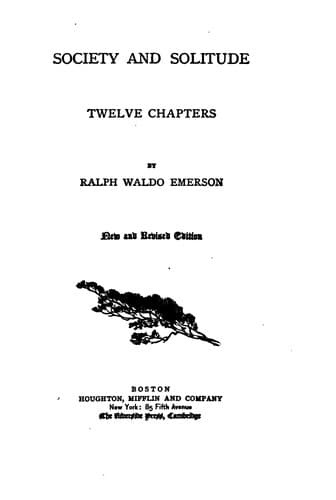
Society and solitude: Twelve chaptersEmerson, Ralph Waldo
Philosophy
Society and solitude: Twelve chapters
Emerson, Ralph Waldo
American essays -- 19th century
He has grave trusts confided to him. In the great household of Nature,
the farmer stands at the door of the bread-room, and weighs to each
his loaf. It is for him to say whether men shall marry or not. Early
marriages and the number of births are indissolubly connected with
abundance of food; or, as Burke said, “Man breeds at the mouth.” Then
he is the Board of Quarantine. The farmer is a hoarded capital of
health, as the farm is the capital of wealth; and it is from him that
the health and power, moral and intellectual, of the cities came.
The city is always recruited from the country. The men in cities who
are the centres of energy, the driving-wheels of trade, politics, or
practical arts, and the women of beauty and genius are the children or
grandchildren of farmers, and are spending the energies which their
fathers’ hardy, silent life accumulated in frosty furrows, in poverty,
necessity, and darkness.
He is the continuous benefactor. He who digs a well, constructs a stone
fountain, plants a grove of trees by the roadside, plants an orchard,
builds a durable house, reclaims a swamp, or so much as puts a stone
seat by the wayside, makes the land so far lovely and desirable, makes
a fortune which he cannot carry away with him, but which is useful to
his country long afterwards. The man that works at home helps society
at large with somewhat more of certainty than he who devotes himself to
charities. If it be true that, not by votes of political parties, but
by the eternal laws of political economy, slaves are driven out of a
slave State as fast as it is surrounded by free States, then the true
abolitionist is the farmer, who, heedless of laws and constitutions,
stands all day in the field, investing his labor in the land, and
making a product with which no forced labor can compete.
We commonly say that the rich man can speak the truth, can afford
honesty, can afford independence of opinion and action;--and that is
the theory of nobility. But it is the rich man in a true sense, that is
to say, not the man of large income and large expenditure, but solely
the man whose outlay is less than his income and is steadily kept so.
In English factories, the boy that watches the loom, to tie the thread
when the wheel stops to indicate that a thread is broken, is called a
_minder_. And in this great factory of our Copernican globe, shifting
its slides; rotating its constellations, times, and tides; bringing
now the day of planting, then of watering, then of weeding, then of
reaping, then of curing and storing,--the farmer is the _minder_. His
machine is of colossal proportions,--the diameter of the water-wheel,
the arms of the levers, the power of the battery, are out of all
mechanic measure;--and it takes him long to understand its parts and
its working. This pump never “sucks”; these screws are never loose;
this machine is never out of gear; the vat and piston, wheels and
tires, never wear out, but are self-repairing.
Public-domain text, read in full here on John Shaqi.
Reviews
Reviews
No reviews yet
Be the first to share your thoughts on this work.
Elsewhere in the archive
Join the Discussion
Join the discussion
Sign in to leave a comment or review.
Sign InorCreate an account