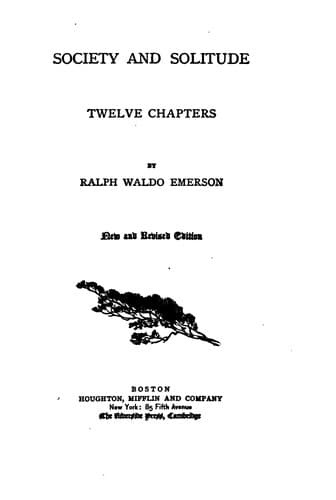
Society and solitude: Twelve chaptersEmerson, Ralph Waldo
Philosophy
Society and solitude: Twelve chapters
Emerson, Ralph Waldo
American essays -- 19th century
The farmer’s office is precise and important, but you must not try to
paint him in rose-color; you cannot make pretty compliments to fate and
gravitation, whose minister he is. He represents the necessities. It is
the beauty of the great economy of the world that makes his comeliness.
He bends to the order of the seasons, the weather, the soils and crops,
as the sails of a ship bend to the wind. He represents continuous hard
labor, year in, year out, and small gains. He is a slow person, timed
to nature, and not to city watches. He takes the pace of seasons,
plants, and chemistry. Nature never hurries: atom by atom, little
by little, she achieves her work. The lesson one learns in fishing,
yachting, hunting, or planting, is the manners of Nature; patience
with the delays of wind and sun, delays of the seasons, bad weather,
excess or lack of water,--patience with the slowness of our feet, with
the parsimony of our strength, with the largeness of sea and land we
must traverse, etc. The farmer times himself to Nature, and acquires
that livelong patience which belongs to her. Slow, narrow man, his rule
is, that the earth shall feed and clothe him; and he must wait for his
crop to grow. His entertainments, his liberties, and his spending must
be on a farmer’s scale, and not on a merchant’s. It were as false for
farmers to use a wholesale and massy expense, as for states to use a
minute economy. But if thus pinched on one side, he has compensatory
advantages. He is permanent, clings to his land as the rocks do. In
the town where I live, farms remain in the same families for seven and
eight generations; and most of the first settlers (in 1635), should
they reappear on the farms to-day, would find their own blood and names
still in possession. And the like fact holds in the surrounding towns.
This hard work will always be done by one kind of man; not by scheming
speculators, nor by soldiers, nor professors, nor readers of Tennyson;
but by men of endurance,--deep-chested, long-winded, tough, slow and
sure, and timely. The farmer has a great health, and the appetite of
health, and means to his end: he has broad lands for his home, wood
to burn great fires, plenty of plain food; his milk, at least, is
unwatered; and for sleep, he has cheaper and better and more of it than
citizens.
Public-domain text, read in full here on John Shaqi.
Reviews
Reviews
No reviews yet
Be the first to share your thoughts on this work.
Elsewhere in the archive
Join the Discussion
Join the discussion
Sign in to leave a comment or review.
Sign InorCreate an account