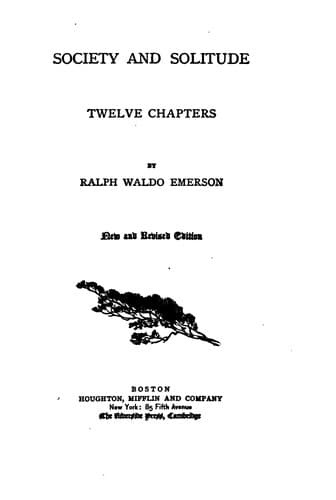
Society and solitude: Twelve chaptersEmerson, Ralph Waldo
Philosophy
Society and solitude: Twelve chapters
Emerson, Ralph Waldo
American essays -- 19th century
There has been a nightmare bred in England of indigestion and spleen
among landlords and loomlords, namely, the dogma that men breed too
fast for the powers of the soil; that men multiply in a geometrical
ratio, whilst corn only in an arithmetical; and hence that, the more
prosperous we are, the faster we approach these frightful limits: nay,
the plight of every new generation is worse than of the foregoing,
because the first comers take up the best lands; the next, the second
best; and each succeeding wave of population is driven to poorer, so
that the land is ever yielding less returns to enlarging hosts of
eaters. Henry Carey of Philadelphia replied: ‘Not so, Mr. Malthus, but
just the opposite of so is the fact.’
The first planter, the savage, without helpers, without tools, looking
chiefly to safety from his enemy,--man or beast,--takes poor land. The
better lands are loaded with timber, which he cannot clear; they need
drainage, which he cannot attempt. He cannot plough, or fell trees, or
drain the rich swamp. He is a poor creature; he scratches with a sharp
stick, lives in a cave or a hutch, has no road but the trail of the
moose or bear; he lives on their flesh when he can kill one, on roots
and fruits when he cannot. He falls, and is lame; he coughs, he has a
stitch in his side, he has a fever and chills: when he is hungry, he
cannot always kill and eat a bear;--chances of war,--sometimes the bear
eats him. ’Tis long before he digs or plants at all, and then only a
patch. Later he learns that his planting is better than hunting; that
the earth works faster for him than he can work for himself,--works
for him when he is asleep, when it rains, when heat overcomes him. The
sun-stroke which knocks him down brings his corn up. As his family
thrive, and other planters come up around him, he begins to fell trees,
and clear good land; and when, by and by, there is more skill, and
tools and roads, the new generations are strong enough to open the
lowlands, where the wash of mountains has accumulated the best soil,
which yield a hundred-fold the former crops. The last lands are the
best lands. It needs science and great numbers to cultivate the best
lands, and in the best manner. Thus true political economy is not
mean, but liberal, and on the pattern of the sun and sky. Population
increases in the ratio of morality: credit exists in the ratio of
morality.
Public-domain text, read in full here on John Shaqi.
Reviews
Reviews
No reviews yet
Be the first to share your thoughts on this work.
Elsewhere in the archive
Join the Discussion
Join the discussion
Sign in to leave a comment or review.
Sign InorCreate an account