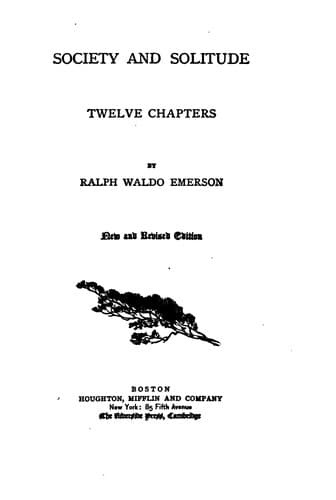
Society and solitude: Twelve chaptersEmerson, Ralph Waldo
Philosophy
Society and solitude: Twelve chapters
Emerson, Ralph Waldo
American essays -- 19th century
Now having our idler safe down as far as the fall of Constantinople in
1453, he is in very good courses; for here are trusty hands waiting for
him. The cardinal facts of European history are soon learned. There
is Dante’s poem, to open the Italian Republics of the Middle Age;
Dante’s “Vita Nuova,” to explain Dante and Beatrice; and Boccaccio’s
“Life of Dante,”--a great man to describe a greater. To help us,
perhaps a volume or two of M. Sismondi’s “Italian Republics” will be
as good as the entire sixteen. When we come to Michel Angelo, his
Sonnets and Letters must be read, with his Life by Vasari, or, in our
day, by Herman Grimm. For the Church, and the Feudal Institution, Mr.
Hallam’s “Middle Ages” will furnish, if superficial, yet readable and
conceivable outlines.
The “Life of the Emperor Charles V.,” by the useful Robertson, is
still the key of the following age. Ximenes, Columbus, Loyola, Luther,
Erasmus, Melanchthon, Francis I., Henry VIII., Elizabeth, and Henry
IV. of France, are his contemporaries. It is a time of seeds and
expansions, whereof our recent civilization is the fruit.
If now the relations of England to European affairs bring him to
British ground, he is arrived at the very moment when modern history
takes new proportions. He can look back for the legends and mythology
to the “Younger Edda” and the “Heimskringla” of Snorro Sturleson, to
Mallet’s “Northern Antiquities,” to Ellis’s “Metrical Romances,” to
Asser’s “Life of Alfred” and Venerable Bede, and to the researches of
Sharon Turner and Palgrave. Hume will serve him for an intelligent
guide, and in the Elizabethan era he is at the richest period of the
English mind, with the chief men of action and of thought which that
nation has produced, and with a pregnant future before him. Here he has
Shakspeare, Spenser, Sidney, Raleigh, Bacon, Chapman, Jonson, Ford,
Beaumont and Fletcher, Herbert, Donne, Herrick; and Milton, Marvell,
and Dryden, not long after.
In reading history, he is to prefer the history of individuals. He will
not repent the time he gives to Bacon,--not if he read the “Advancement
of Learning,” the “Essays,” the “Novum Organum,” the “History of
Henry VII.,” and then all the “Letters” (especially those to the
Earl of Devonshire, explaining the Essex business), and all but his
“Apophthegms.”
Public-domain text, read in full here on John Shaqi.
Reviews
Reviews
No reviews yet
Be the first to share your thoughts on this work.
Elsewhere in the archive
Join the Discussion
Join the discussion
Sign in to leave a comment or review.
Sign InorCreate an account