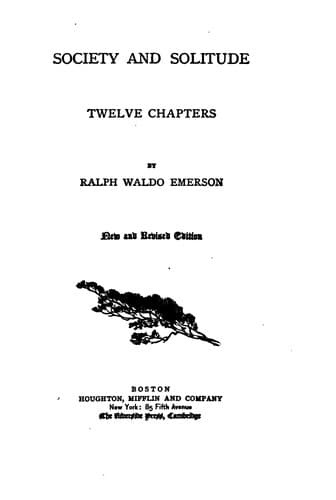
Society and solitude: Twelve chaptersEmerson, Ralph Waldo
Philosophy
Society and solitude: Twelve chapters
Emerson, Ralph Waldo
American essays -- 19th century
In youth, in the fury of curiosity and acquisition, the day is too
short for books and the crowd of thoughts, and we are impatient of
interruption. Later, when books tire, thought has a more languid flow;
and the days come when we are alarmed, and say there are no thoughts.
‘What a barren-witted pate is mine!’ the student says; ‘I will go and
learn whether I have lost my reason.’ He seeks intelligent persons,
whether more wise or less wise than he, who give him provocation,
and at once and easily the old motion begins in his brain: thoughts,
fancies, humors flow; the cloud lifts; the horizon broadens; and
the infinite opulence of things is again shown him. But the right
conditions must be observed. Mainly he must have leave to be himself.
Sancho Panza blessed the man who invented sleep. So I prize the good
invention whereby everybody is provided with somebody who is glad to
see him.
If men are less when together than they are alone, they are also in
some respects enlarged. They kindle each other; and such is the power
of suggestion, that each sprightly story calls out more; and sometimes
a fact that had long slept in the recesses of memory hears the voice,
is welcomed to daylight, and proves of rare value. Every metaphysician
must have observed, not only that no thought is alone, but that
thoughts commonly go in pairs; though the related thoughts first
appeared in his mind at long distances of time. Things are in pairs:
a natural fact has only half its value, until a fact in moral nature,
its counterpart, is stated. Then they confirm and adorn each other; a
story is matched by another story. And that may be the reason why, when
a gentleman has told a good thing, he immediately tells it again.
Nothing seems so cheap as the benefit of conversation: nothing is more
rare. ’Tis wonderful how you are balked and baffled. There is plenty
of intelligence, reading, curiosity; but serious, happy discourse,
avoiding personalities, dealing with results, is rare: and I seldom
meet with a reading and thoughtful person but he tells me, as if it
were his exceptional mishap, that he has no companion.
Public-domain text, read in full here on John Shaqi.
Reviews
Reviews
No reviews yet
Be the first to share your thoughts on this work.
Elsewhere in the archive
Join the Discussion
Join the discussion
Sign in to leave a comment or review.
Sign InorCreate an account