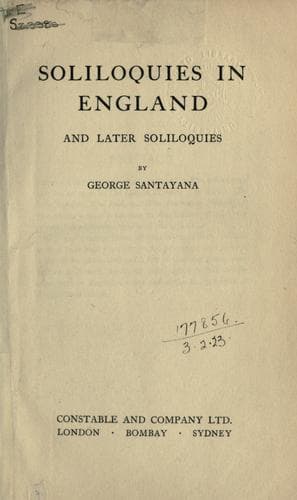
Soliloquies in England, and Later SoliloquiesSantayana, George
Philosophy
Soliloquies in England, and Later Soliloquies
Santayana, George
American essays -- 20th century
How many an English spirit, too modest to be heard here, has now
committed its secret to that same heaven! Caught by the impulse of the
hour, they rose like larks in the morning, cheerily, rashly, to meet
the unforeseen, fatal, congenial adventure, the goal not seen, the air
not measured, but the firm heart steady through the fog or blinding
fire, making the best of what came, trembling but ready for what might
come, with a simple courage which was half joy in living and half
willingness to die. Their first flight was often their last. What fell
to earth was only a poor dead body, one of a million; what remained
above perhaps nothing to speak of, some boyish sally or wistful fancy,
less than the song of a lark for God to treasure up in his omniscience
and eternity. Yet these common brave fools knew as well as the lark
the thing that they could do, and did it; and of other gifts and other
adventures they were not envious. Boys and free men are always a
little inclined to flout what is not the goal of their present desires,
or is beyond their present scope; spontaneity in them has its ebb-flow
in mockery. Their tight little selves are too vigorous and too clearly
determined to brood much upon distant things; but they are true to
their own nature, they know and love the sources of their own strength.
Like the larks, those English boys had drunk here the quintessence of
many a sunlit morning; they had rambled through these same fields,
fringed with hedges and peeping copse and downs purple with heather;
these paths and streams had enticed them often; they had been vaguely
happy in these quiet, habitable places. It was enough for them to live,
as for nature to revolve; and fate, in draining in one draught the
modest cup of their spirit, spared them the weary dilution and waste of
it in the world. The length of things is vanity, only their height is
joy.
Of myself also I would keep nothing but what God may keep of me--some
lovely essence, mine for a moment in that I beheld it, some object
of devout love enshrined where all other hearts that have a like
intelligence of love in their day may worship it; but my loves
themselves and my reasonings are but a flutter of feathers weaker than
a lark's, a prattle idler than his warblings, happy enough if they too
may fly with him and die with him at the gate of heaven.
LATER SOLILOQUIES
1918-1921
28
SOCIETY AND SOLITUDE
Public-domain text, read in full here on John Shaqi.
Reviews
Reviews
No reviews yet
Be the first to share your thoughts on this work.
Elsewhere in the archive
Join the Discussion
Join the discussion
Sign in to leave a comment or review.
Sign InorCreate an account