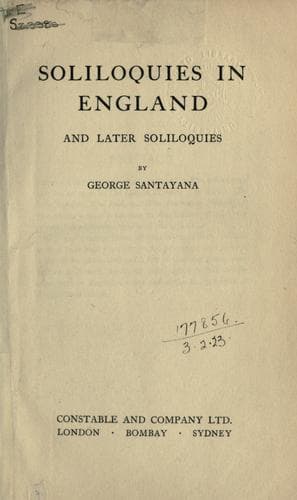
Soliloquies in England, and Later SoliloquiesSantayana, George
Philosophy
Soliloquies in England, and Later Soliloquies
Santayana, George
American essays -- 20th century
This extension of names is inevitable although unfortunate, because
language and perception are poetical before they become scientific,
if they ever do; as Aristotle observes that the word anger is used
indifferently for two different things: dialectically, or as I call
it, imaginatively, for the desire for revenge, but physically for a
boiling of the humours. And utterly different as these two things are
in quality, no great inconvenience results from giving them the same
name, because historically they are parts of the same event. Nature
has many dimensions at once, and whenever we see anything happen, much
else is happening there which we cannot see. Whilst dreams entertain
us, the balance of our character is shifting beneath: we are growing
while we sleep. The young think in one way, the drunken in another, and
the dead not at all; and I imagine--for I have imagination myself--that
they do not die because they stop thinking, but they stop thinking
because they die. How much veering and luffing before they make that
port I The brain of man, William James used to say, has a hair-trigger
organization. His life is terribly experimental. He is perilously
dependent on the oscillations of a living needle, imagination, that
never points to the true north.
There are books in which the footnotes, or the comments scrawled
by some reader's hand in the margin, are more interesting than the
text. The world is one of these books. The reciprocal interference of
magnetic fields (which I understand is the latest conception of matter)
may compose a marvellous moving pattern; but the chief interest to
us of matter lies in its fertility in producing minds and presenting
recognizable phenomena to the senses; and the chief interest of any
scientific notion of its intrinsic nature lies in the fact that, if not
literally true, it may liberate us from more misleading conceptions.
Did we have nothing but electrical physics to think of, the nightmare
would soon become intolerable. But a hint of that kind, like a hasty
glance into the crater of a volcano, sends a wholesome shudder through
our nerves; we realize how thin is the crust we build on, how mythical
and remote from the minute and gigantic scale of nature are the bright
images we seem to move among, all cut out and fitted to our human
stature. Yet these bright images are our natural companions, and if
we do not worship them idolatrously nor petrify them into substances,
forgetting the nimble use of them in mental discourse, which is
where they belong, they need not be more misleading to us, even for
scientific purposes, than are words or any other symbols.
Public-domain text, read in full here on John Shaqi.
Reviews
Reviews
No reviews yet
Be the first to share your thoughts on this work.
Elsewhere in the archive
Join the Discussion
Join the discussion
Sign in to leave a comment or review.
Sign InorCreate an account