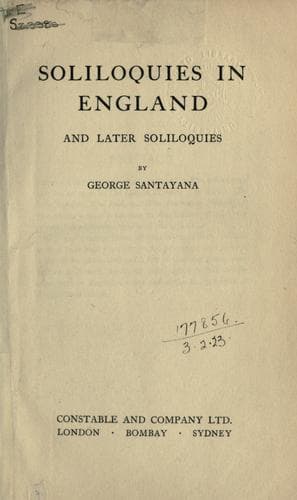
Soliloquies in England, and Later SoliloquiesSantayana, George
Philosophy
Soliloquies in England, and Later Soliloquies
Santayana, George
American essays -- 20th century
Nor is this amphibious moral quality limited to the passions; all facts
and objects in nature can take on opposite moral tints. When abstracted
from our own presence and interests, everything that can be found or
imagined is reduced to a mere essence, an ideal theme picked out of
the infinite, something harmless, marvellous, and pure, like a musical
rhythm or geometrical design. The whole world then becomes a labyrinth
of forms and motions, a castle in the clouds built without labour and
dissolved without tears. The moment the animal will reawakes, however,
these same things acquire a new dimension; they become substantial,
not to be created without effort nor rent without resistance; at the
same time they become objects of desire and fear; we are so engrossed
in existence that every phenomenon becomes questionable and ominous,
and not so much a free gift and manifestation of its own nature as a
piece of good or bad news. We are no longer surprised, as a free spirit
would be, at the extraordinary interest we take in things turning out
one way rather than another. We are caught in the meshes of time and
place and care; and as the things we have set our heart on, whatever
they may be, must pass away in the end, either suddenly or by a gentle
transformation, we cannot take a long view without finding life sad,
and all things tragic. This aspect of vanity and self-annihilation,
which existence wears when we consider its destiny, is not to be denied
or explained away, as is sometimes attempted in cowardly and mincing
philosophies. It is a true aspect of existence in one relation and on
a certain view; but to take this long view of existence, and look down
the avenues of time from the station and with the emotions of some
particular moment, is by no means inevitable, nor is it a fair and
sympathetic way of viewing existence. Things when they are actual do
not lie in that sort of sentimental perspective, but each is centred
in itself; and in this intrinsic aspect existence is nothing tragic
or sad, but rather something joyful, hearty, and merry. A buoyant
and full-blooded soul has quick senses and miscellaneous sympathies:
it changes with the changing world; and when not too much starved or
thwarted by circumstances, it finds all things vivid and comic. Life
is free play fundamentally and would like to be free play altogether.
In youth anything is pleasant to see or to do, so long as it is
spontaneous, and if the conjunction of these things is ridiculous, so
much the better: to be ridiculous is part of the fun.
Public-domain text, read in full here on John Shaqi.
Reviews
Reviews
No reviews yet
Be the first to share your thoughts on this work.
Elsewhere in the archive
Join the Discussion
Join the discussion
Sign in to leave a comment or review.
Sign InorCreate an account