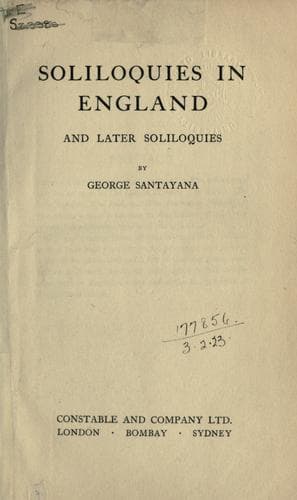
Soliloquies in England, and Later SoliloquiesSantayana, George
Philosophy
Soliloquies in England, and Later Soliloquies
Santayana, George
American essays -- 20th century
Existence is indeed distinguishable from the platonic essences that
are embodied in it precisely by being a conjunction of things mutually
irrelevant, a chapter of accidents, a medley improvised here and now
for no reason, to the exclusion of the myriad other farces which, so
far as their ideal structure is concerned, might have been performed
just as well. This world is contingency and absurdity incarnate, the
oddest of possibilities masquerading momentarily as a fact. Custom
blinds persons who are not naturally speculative to the egregious
character of the actual, because custom assimilates their expectations
to the march of existing things and deadens their power to imagine
anything different. But wherever the routine of a barbaric life is
broken by the least acquaintance with larger ways, the arbitrariness
of the actual begins to be discovered. The traveller will first learn
that his native language is not the only one, nor the best possible,
nor itself constant; then, perhaps, he will understand that the same
is true of his home religion and government. The naturalist will
begin by marvelling at the forms and habits of the lower animals,
while continuing to attribute his own to their obvious propriety;
later the heavens and the earth, and all physical laws, will strike
him as paradoxically arranged and unintelligible; and ultimately the
very elements of existence--time, change, matter, habit, life cooped
in bodies--will reveal themselves to him in their extreme oddity, so
that, unless he has unusual humility and respect for fact, he will
probably declare all these actual things to be impossible and therefore
unreal. The most profound philosophers accordingly deny that any of
those things exist which we find existing, and maintain that the only
reality is changeless, infinite, and indistinguishable into parts; and
I call them the most profound philosophers in spite of this obvious
folly of theirs, because they are led into it by the force of intense
reflection, which discloses to them that what exists is unintelligible
and has no reason for existing; and since their moral and religious
prejudices do not allow them to say that to be irrational and
unintelligible is the character proper to existence, they are driven to
the alternative of saying that existence is illusion and that the only
reality is something beneath or above existence. That real existence
should be radically comic never occurs to these solemn sages; they are
without one ray of humour and are persuaded that the universe too must
be without one. Yet there is a capital joke in their own systems, which
prove that nothing exists so strenuously, that existence laughs aloud
in their vociferations and drowns the argument. Their conviction is
the very ghost which it rises to exorcise; yet the conviction and the
exorcism remain impressive, because they bear witness to the essential
strangeness of existence to the spirit. Like the Ghost in _Hamlet_
Public-domain text, read in full here on John Shaqi.
Reviews
Reviews
No reviews yet
Be the first to share your thoughts on this work.
Elsewhere in the archive
Join the Discussion
Join the discussion
Sign in to leave a comment or review.
Sign InorCreate an account