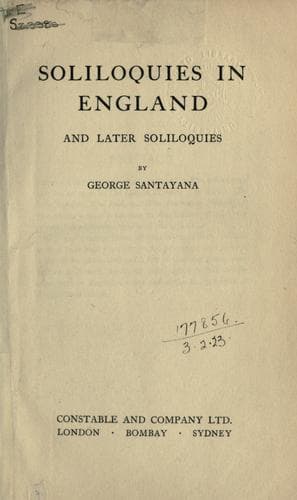
Soliloquies in England, and Later SoliloquiesSantayana, George
Philosophy
Soliloquies in England, and Later Soliloquies
Santayana, George
American essays -- 20th century
Nature, which is far more resourceful than logic, has found a way out
of the contradiction between the human need for expression and the
British distaste for personal outbursts. This way is rambling fiction.
When out of shyness, or because they have shocked each other, the
inner man and the outer man are not on speaking terms, loud language
and vehement gestures are incompatible with depth of feeling. What
lies deep must in such a case remain unexpressed, and will seem
inexpressible. A man's heart will be revealed, even to himself, only
in long stretches of constant endeavour and faithful habit: towards
the end of his life he may begin to discern his ruling motives. In
the meantime, however, his fancy may have played at self-revelation;
he may have indulged in day-dreams and romantic transformations of
himself, as boys do; and without pledging his real person too much he
may have made trial of candour, or, if need be, of extravagance, in
imaginary substitutes for himself, thus trying the paces of his inner
man without cheapening his secret feelings or publishing them in common
and second-hand terms. Such a man will talk little about himself; his
opinions and preferences will not be very explicit, but he will privily
nurse and develop them by endless variations played upon them in fancy,
as he reads or perhaps writes a book of fiction by his chimney corner.
He will dream of what Queen Mab makes other people dream.
Romantic fiction is a bypath of expression; it meanders through fields
of possible experience that stretch harmlessly between the highroads of
actual lives, far from the precipices of private and public passions.
The labyrinth is infinite, but the path chosen in it is always
traceable by a sort of Ariadne's thread spun out of the poet's heart.
He means to forget himself and to feign some charming monster in some
picturesque landscape, the more exotic the better; but in doing so he
obeys the dream-impulses of his own soul, and recasts or corrects the
images supplied by his experience. His very extravagances and hectic
concentration of fancy betray him; they manifest his impatience, his
affections, his potentialities; for he paints what he can conceive and
what fascinates him in conceiving it. That which he might have been,
and was not, comforts him. Such a form of self-expression, indirect,
bashful, and profoundly humorous, being play rather than art, is
alone congenial to the British temperament; it is the soul of English
literature. Like English politics and religion, it breathes tolerance,
plasticity, waywardness, infinitude; it is tender and tentative,
shapeless and guileless. Its straggling march forms a vast national
soliloquy, rich in casual touches, in alternatives, in contrasts, in
suspended themes; the plot grows out of the episodes, it is always
being remodelled and always to be continued. The facts, though much
talked of in detail, are never faced as a whole, nor is the soul ever
Public-domain text, read in full here on John Shaqi.
Reviews
Reviews
No reviews yet
Be the first to share your thoughts on this work.
Elsewhere in the archive
Join the Discussion
Join the discussion
Sign in to leave a comment or review.
Sign InorCreate an account