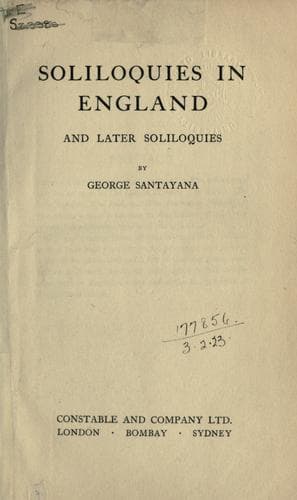
Soliloquies in England, and Later SoliloquiesSantayana, George
Philosophy
Soliloquies in England, and Later Soliloquies
Santayana, George
American essays -- 20th century
This story may be a fairy tale or it may be a piece of realistic
fiction, in which the experiences of sundry characters, as different
as possible from oneself and from one another, are imagined and lived
through. The author may fairly say that these creations are not masks
for his own person; it is expressly not his own feelings that he is
evoking and developing. He is fancying other feelings; and yet, as
this fancy and the magic life it constitutes are necessarily his own,
his mind is being secretly agitated and relieved by these fictions;
and his sensibility, instead of being sublimated into some ultimate
tragic passion, is diffused over a thousand picturesque figures and
adventures with which he acknowledges no moral kinship, save such as
is requisite for a lively interest in them and a minute portrayed. It
is only by accident that any of his poetic offspring may resemble their
parent. What cares he what curious eye may note their deformity? _He_
need not blush for them. He may even be bent on unmasking and fiercely
condemning them, as a scrupulous penitent is bent on ferreting out
and denouncing his real or fancied sins. In the most searching truth
of fiction there is accordingly no indiscretion; the author's inmost
and least avowable feelings may be uttered through it without reserve.
Like a modest showman behind the curtain of his booth, he manipulates
his marionettes and speaks for them in a feigned voice, by a sort of
ventriloquy. Here is no religious tragedy, no distilled philosophy, no
overarching cosmic myth. The scale is pleasantly small and the tone
familiar, though the sum of the parts may fade into the infinite. We
do not find in this complicated dream any life greater than our own
or less accidental. We do not need to outgrow ourselves in order to
understand it; no one summons us to pause, to recant, to renounce any
part of our being. On the contrary, we simply unwind our own reel; we
play endlessly at living, and in this second visionary life we survive
all catastrophes, and we exchange one character for another without
carrying over any load of memory or habit or fate. We seem still to
undergo the vicissitudes of a moral world, but without responsibility.
Public-domain text, read in full here on John Shaqi.
Reviews
Reviews
No reviews yet
Be the first to share your thoughts on this work.
Elsewhere in the archive
Join the Discussion
Join the discussion
Sign in to leave a comment or review.
Sign InorCreate an account