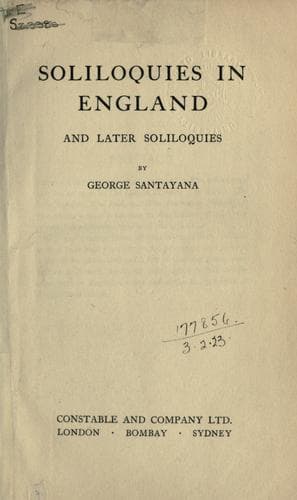
Soliloquies in England, and Later SoliloquiesSantayana, George
Philosophy
Soliloquies in England, and Later Soliloquies
Santayana, George
American essays -- 20th century
How vast, how kindly,
how enveloping does the world of Shakespeare seem in comparison! We
seem to be afloat again on the tide of time, in a young, green world;
we are ready to tempt new fortunes, in the hope of reaching better
things than we know. And this is the right spirit; because although
the best, if it had been attained, would be all-sufficient, the best is
not yet.
37
THE CENSOR AND THE POET
There is an important official of the inner man who in the latest
psychology is called the Censor; his function is to forbid the
utterance, in the council chamber within us, of unparliamentary
sentiments, and to suppress all reports not in the interest of our
moral dignity. By relegating half our experience to oblivion and
locking up our unseemly passions in solitary dungeons, the Censor
composes a conventional personage that we may decently present to
the world. It is he, whilst we are sane and virtuous, that regulates
our actions. It had occurred to me sometimes that the Censor was
only another name for our old friend Reason; but there is a great
difference. This is no censor of the noble Roman sort, like Cato
Major; he makes no attempt to purify the republic from within; he is
not concerned with moral health, honest harmony, and the thorough
extirpation of hopeless rebels. He is concerned only with appearances
and diplomatic relations; his old name was not Reason but Vanity or
Self-love. He is merely the head of the government propaganda, charged
with preventing inconvenient intelligence of our psychological home
politics from reaching foreign powers or weakening the _moral_ of our
fighting force. He is the father of shams. He invents those masterly
methods of putting our best foot forward, and sustaining the illusion
that we are always actuated by becoming and avowable motives. He it
is that dictates the polite movements by which we show that we prefer
the comfort of others to our own. He causes us to put on mourning
for those who have left us legacies. He persuades us that we believe
in the religion of our ancestors, in the science of the day, in the
national cause, and in the party cry. He leads us to admire the
latest art, or the most ancient; he enables us to be pleased with
every fashion in turn, or perhaps to sigh at its ugliness, if we are
conscious of being the best-dressed persons in the room. He induces
us to follow the doings of the royal family with affectionate awe, to
love our relations, to prefer Bach to Offenbach, and always to have
had a good time when we leave a friend's house. The Censor sends our
children to the best schools, to prove what sacrifices we are willing
to make for their good, and to relieve us of further responsibility
in regard to them. He directs that considerations of wealth shall
control our careers, our friendships, and our manners; and this is
perhaps the greatest sham of all the shams he has set up: that money
is an expression of happiness and a means to it. What opens the way to
Public-domain text, read in full here on John Shaqi.
Reviews
Reviews
No reviews yet
Be the first to share your thoughts on this work.
Elsewhere in the archive
Join the Discussion
Join the discussion
Sign in to leave a comment or review.
Sign InorCreate an account