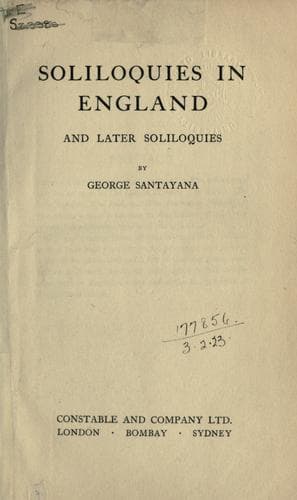
Soliloquies in England, and Later SoliloquiesSantayana, George
Philosophy
Soliloquies in England, and Later Soliloquies
Santayana, George
American essays -- 20th century
The worst mutiny in the _Saint Christopher_, however, was of quite
another kind. The remaining crew had no objection to the captain--they
were human themselves--and no desire to paddle their own canoes. But
they got thoroughly weary of sailing day after day into the same
sunset, decided that there was no El Dorado, and insisted clamorously
on putting the ship about. But in what direction? Some were for going
home; they said all talk of another world was nonsense, that those
Hopes and Miracles were worthless, and that the only thing to do was
to return to the old country and live there in the old way, making the
best of it. But the majority said that such an acknowledgment of defeat
and error would be ignominious; and that life at home, never really
happy, would now be doubly intolerable. They would never have set out
on so problematical an expedition, had they found life possible in
their native seats. But it had been horrible. They remembered with a
shudder the cruelties and vanities of their ancestral heathenism. They
were adventurers and mariners by nature. They might be now bewildered
for a moment and discouraged in their explorations, but the impulse to
hope for the better and to try the unknown was ineradicable in their
breast.
In some of them, indeed, this brave impulse was so vigorous, that
they now had a sudden intuition of the romantic principle of life, and
harangued their companions as follows:
"What need, O shipmates, to sail for _any_ port? The sailor is not a
land animal. How we chafed and stifled when we lived on _terra firma_,
pent in those horrible stone dungeons called houses and churches, and
compelled to till those inert and filthy clods, year in and year out--a
most stupefying existence! Let us sail for the sake of sailing. It was
not in putting forth into this infinite sea that we were ill-advised,
but only in imagining that we could reach an opposite shore, and that
the sea was not infinite but hemmed about by dead land. That was a
gross illusion. In reality there is no _terra firma_ at all, but only
ships and rafts more or less extensive, covered over with earth and
trees, riding on the water. Fancy deceived us, when we supposed that
our Earth was anchored in some deeper earth. It floats and drifts
upon a bottomless flood, and will dissolve into it. Do not dream of
any backward voyage, or of reaching home. You will never find that
old home again; it exists no longer. But this good ship of ours,
with its wind-blown sails, can never sink and can never stop. If the
banners and crosses, which we still fly in deference to custom, have
lost their meaning for us, other symbols will take their place. We
must not confuse our infinite task with the illusions that may first
have prompted us to undertake it. A brave and an endless life awaits
us, battling with the storms of winter; in the summer days, leaping
over the waves with the dolphins and the porpoises; in the watches
Public-domain text, read in full here on John Shaqi.
Reviews
Reviews
No reviews yet
Be the first to share your thoughts on this work.
Elsewhere in the archive
Join the Discussion
Join the discussion
Sign in to leave a comment or review.
Sign InorCreate an account