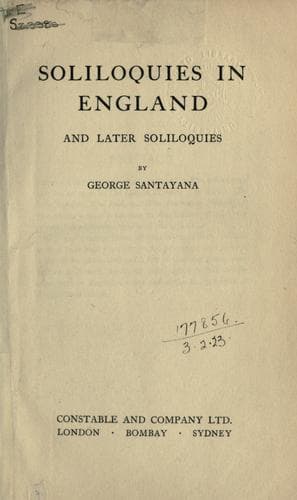
Soliloquies in England, and Later SoliloquiesSantayana, George
Philosophy
Soliloquies in England, and Later Soliloquies
Santayana, George
American essays -- 20th century
Whether these prizes offered by liberal society are worth winning, I
cannot say from experience, never having desired them; but the aspects
of modern life which any one may observe, and the analytic picture
of it which the novelists supply, are not very attractive. Wealth is
always, even when most secure, full of itch and fear; worry about
health, children, religion, marriage, servants; and the awful question
of where to live, when one may live anywhere, and yet all seems to
depend on the choice. For the politician, politics are less important
than his private affairs, and less interesting than bridge; and he has
always a party, or a wicked opposition, on which to throw the blame if
his careless measures turn out badly. No one in office can be a true
statesman, because a true statesman is consistent, and public opinion
will never long support any consistent course. What the successful man
in modern society really most cares about is love; love for him is a
curious mixture of sensuality, vanity, and friendship; it lights up
all the world of his thought and action with its secret and unsteady
flame. Even when mutual and legal, it seems to be three-quarters
anxiety and sorrow; for if nothing worse happens to lovers, they grow
old. I hear no laughter among the rich which is not forced and nervous.
I find no sense of moral security amongst them, no happy freedom, no
mastery over anything. Yet this is the very cream of liberal life, the
brilliant success for the sake of which Christendom was overturned,
and the dull peasantry elevated into factory-hands, shopkeepers, and
chauffeurs. When the lists are open to all, and the one aim of life is
to live as much as possible like the rich, the majority must needs be
discouraged. The same task is proposed to unequal strengths, and the
competition emphasizes the inequality. There was more encouragement
for mediocre people when happiness was set before them in mediocrity,
or in excellence in some special craft. Now the mass, hopelessly out
of the running in the race for wealth, falls out and drifts into
squalor. Since there is liberty, the listless man will work as little
and drink as much as he can; he will crawl into whatever tenement he
can get cheapest, seek the society in which least effort is demanded
and least shame is felt, have as many children as improvidence sends
him, let himself out, at a pinch, for whatever service and whatever
wages he can obtain, drift into some syndicated servitude or some great
migration, or sink in solitude into the deepest misery. He then becomes
a denizen of those slimy quarters, under the shadow of railway bridges,
breweries, and gas-works, where the blear lights of a public-house peer
through the rain at every corner, and offer him the one joy remaining
in life; for joy is not to be mentioned in the same breath as the
female prowling by the door, hardly less befuddled and bedraggled
than the lurching idlers whom she endeavours to entice; but perhaps
Public-domain text, read in full here on John Shaqi.
Reviews
Reviews
No reviews yet
Be the first to share your thoughts on this work.
Elsewhere in the archive
Join the Discussion
Join the discussion
Sign in to leave a comment or review.
Sign InorCreate an account