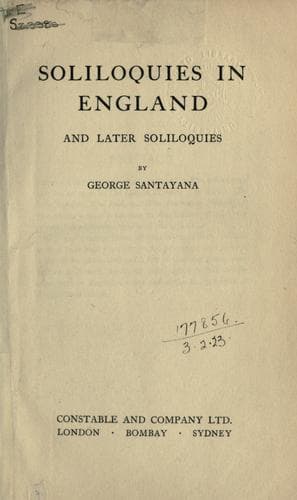
Soliloquies in England, and Later SoliloquiesSantayana, George
Philosophy
Soliloquies in England, and Later Soliloquies
Santayana, George
American essays -- 20th century
Besides, on its technical side, the Hegelian system has a great
strength, and was most apposite in the predicament in which, fifty
years ago, philosophy found itself in England. It supplied three
illusions which idealism sadly needed if it was to become orthodox and
popular: the illusions of profundity, of comprehensiveness, and of
finality. It was a philosophy of progress--another claim to popularity
in the nineteenth century--not only progress in the world at large,
but especially in philosophy itself; and a philosophy of progress
cannot ask us to go back, to cry _peccavi_, and reconsider the false
assumptions on which we may have been reasoning for two hundred or for
two thousand years. It must accept these assumptions and go on building
upon them, always a higher and a higher structure. Now the principal
assumption of British philosophy, on which German philosophy itself
rests, was that nothing can be experienced except experience itself,
and nothing known except knowledge. But the Germans analysed far more
accurately than the British had formerly done what the notions of
experience and knowledge contain. They demonstrated the unity of glance
that is essential to it, and thus refuted (without of course removing)
the successive and episodic character of experience, as the honest
but unwary empiricists had conceived it. Hume and Mill had remained
naturalists in regard to the distribution of those volatile ideas
to which they pretended to reduce the world. John Stuart Mill had a
deeper and a sweeter mind than his critics; there was something in him
akin to Wordsworth or to Matthew Arnold; but his inherited principles
were treacherous, and opened the door to just such a concentration
of egotism as the Hegelians brought about. Moreover, Hume and Mill
had seemed depressing; they perplexed without filling the mind; they
made everything that is most familiar and interesting seem strangely
hypothetical; whereas in Hegel the pageant of nature and history
appeared to be re-formed and to march round and round the stage of the
ego under the strongest light to the loudest music. There was a sort of
deafening optimism about it; and not only was a convenient school-book
universe offered you, warranted complete, but all previous philosophies
were succinctly described, refuted, and linked together, in a manner
most convenient for tutorial purposes. Of course, the true character
and eternal plausibility of each great system were falsified in such
a survey; each was attached artificially to what happened to precede
and to follow it in time, or in the knowledge of the historian; as if
history were a single chain of events, and its march dialectical--a
fiction which Hegel did not blush to maintain. An inner instability was
thus attributed to each view which came only from the slippery mind
of the critic touring amongst them, without the least intention of
finding anywhere a home in which to rest. Hegel was not looking for the
Public-domain text, read in full here on John Shaqi.
Reviews
Reviews
No reviews yet
Be the first to share your thoughts on this work.
Elsewhere in the archive
Join the Discussion
Join the discussion
Sign in to leave a comment or review.
Sign InorCreate an account