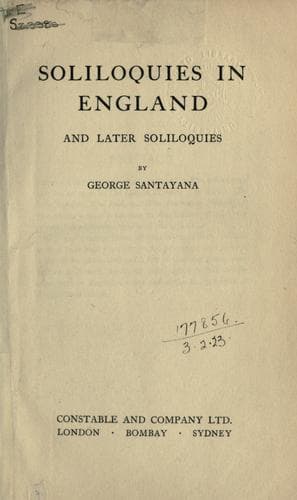
Soliloquies in England, and Later SoliloquiesSantayana, George
Philosophy
Soliloquies in England, and Later Soliloquies
Santayana, George
American essays -- 20th century
That this order of human life is something natural, and not a fiction
of discourse, appears in many ways. The relation of discourse itself
to physical life is one proof of it. Mental discourse is the inner
luminosity or speech that accompanies dramatic crises in the fortunes
of the body; it is not self-generated; it is always the _expression_ of
another event, then occurring in the body, as is a cry of pain; and it
is usually, at the same time, a _report_ of still another event that
has already occurred beyond the body, as is a memory or a perception.
Feeling and thought are perpetually interrupted and perpetually
renewed by something not themselves. Their march, logic, and sanity,
no less than their existence, translate into mental language an order
proper to material events. A sense of comfort is the symptom of a good
digestion; pain expresses a lively discord in the nervous system, and
pleasure a lively harmony. When we can scarcely live, because something
is stifling us, we hate that thing; and when we breathe more freely
because something approaches, we love it. Spirit everywhere expresses
the life of nature, and echoes its endeavours; but the animal life
which prompts these feelings is itself not arbitrary: it passes through
a cycle of changes which are pre-ordained. This predetermined, specific
direction of animal life is the key to everything moral; without it
no external circumstance could be favourable or unfavourable to us;
and spirit within us would have no reason to welcome, to deplore, or
to notice anything. What an anomaly it would seem to a free spirit
(if there could be such a thing) that it should care particularly for
what happens in the body of some animal, or that it should see one set
of facts rattier than another, and this in so partial and violent a
perspective! But spirit does, and must, do this; and it is an absurd
and satanic presumption on its part to profess that it could exist,
or be a spirit at all, if it were not the spirit of some body, the
voice of some animal heart. To have a station in matter, and to have
interests in the material world, are essential to spirit, because
spirit is life become articulate, experience focussed in thought and
dominated ideally; but experience and life are inconceivable unless
an organism with specific capacities and needs finds itself in an
environment that stimulates it variously and offers it a conditioned
career.
Public-domain text, read in full here on John Shaqi.
Reviews
Reviews
No reviews yet
Be the first to share your thoughts on this work.
Elsewhere in the archive
Join the Discussion
Join the discussion
Sign in to leave a comment or review.
Sign InorCreate an account