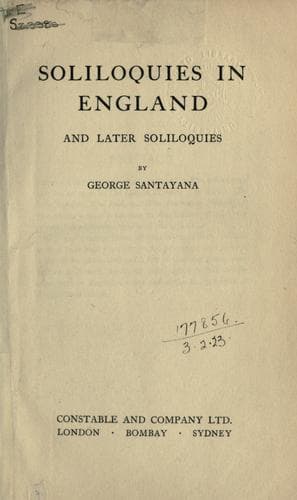
Soliloquies in England, and Later SoliloquiesSantayana, George
Philosophy
Soliloquies in England, and Later Soliloquies
Santayana, George
American essays -- 20th century
Here, perhaps by chance, the word is used with absolute propriety and
its chief implications are indicated. An Idea is something seen, an
_immediate_ presence; it is something seen in a dream, or _imaginary_;
and it is the same Idea when seen a second time, or a _universal_.
That universals are present to intuition was the secret of Plato;
yet it is the homeliest of truths. It comes to seem a paradox, or
even inconceivable, because people suppose they see what they believe
they are looking at, which is some particular thing, the object of
investigation, of desire, and of action; they overlook the terms of
their thought, as they overlook the perspective of the landscape. These
terms, which are alone immediate, are all universals. Belief--the
expectation, fear, or sense of events hidden or imminent--precedes
clear perception; but it is supposed to be derived from it. Perception
without belief would be mere intuition of Ideas, and no belief in
things or ulterior events could ever be based on it. A seraph who
should know only Ideas would be incapable of conceiving any fact, or
noting any change, or discovering his own spiritual existence; he would
be mathematics actualized, a landscape self-composed, and love spread
like butter. The human mind, on the contrary, is the expression of an
animal life, swimming hard in the sea of matter. It begins by being
the darkest belief and the most helpless discomfort, and it proceeds
gradually to relieve this uneasiness and to tincture this blind faith
with more and more luminous Ideas, Ideas, in the discovery of facts,
are only graphic symbols, the existence and locus of the facts thus
described being posited in the first place by animal instinct and
watchfulness. If we suspend these eager explorations for a moment, and
check our practical haste in understanding the material structure of
things and in acting upon them, it becomes perfectly obvious that the
data of actual intuition are sounds, figures, movements, landscapes,
stories--all universal essences appearing, and perhaps reappearing, as
in a trance.
I think that Plato in his youth must have seen his Ideas with this
mystical directness, and must have felt the irritation common to
mystics at being called back out of that poetic ecstasy into the
society of material things. Those essences were like the gods, dear and
immortal, however fugitive our vision of them might be; whereas things
were in their inmost substance intricate and obscure and treacherously
changeable; you could never really know what any of them was, nor
what it might become. The Ideas were our true friends, our natural
companions, and all our safe knowledge was of them; things were only
vehicles by which Ideas were conveyed to us, as the copies of a book
are vehicles for its sense.
Public-domain text, read in full here on John Shaqi.
Reviews
Reviews
No reviews yet
Be the first to share your thoughts on this work.
Elsewhere in the archive
Join the Discussion
Join the discussion
Sign in to leave a comment or review.
Sign InorCreate an account