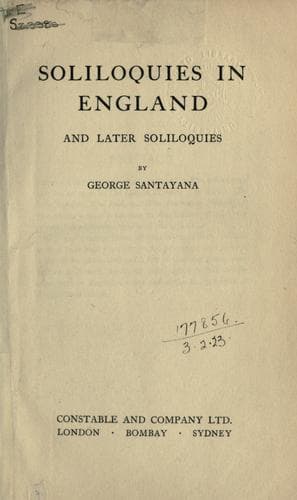
Soliloquies in England, and Later SoliloquiesSantayana, George
Philosophy
Soliloquies in England, and Later Soliloquies
Santayana, George
American essays -- 20th century
Accordingly it was with a vague hope and a secret desire for vengeance
that she heard of the approach of a brilliant stranger, from a far more
populous and flourishing city than Sparta, who came with gifts and a
glib tongue to view the wonders of the island world. When his eyes fell
on her, his unfeigned surprise filled her with exultation. To be so
discerned, for her, was to be won. Those eyes could recognize divinity.
No doubt he was preparing new fetters for her and new sorrows, but for
a moment she would be free, and in following him she would feel herself
once more the goddess.
In fact, so long as they sailed the dark-purple sea, or rested in
caves or in island bowers, all was pleasantness between them. Their
very galley, with its white sails spread, took on something of Helen's
beauty, and seemed a cloud wafted across the Aegean, or the swan, her
father, riding on the rippled reaches of the Meander. Paris proved
a candid and light-hearted lover; never vexed, he was all grace and
mastery in small matters: one of those lordly travellers who can feel
the charm of nature and of woman in every dime, however exotic, however
pure, or however impure; and the incomparable Helen seemed indeed
incomparable to his practised mind. He adored her, but he preferred
other women. Moreover, she found that at Troy he counted for nothing.
He moved amid battles and councils, quite at home in the scene, but
never consulted; a prince turned shepherd, a familiar but superfluous
ornament, like a fop or a ballet-dancer that everybody smiled upon and
nobody respected. It was given him in the end to slay the redoubtable
Achilles with a chance arrow, Apollo secretly directing the shaft,
but he was no warrior. It was a useless triumph, as his abduction of
Helen had been an innocent crime: both were the work of gods laughing
at human arrogance. There were doubtless street rhetoricians in Ilium
who upbraided Paris and Helen, as there are reasoning philosophers
and politicians to-day who attribute the ascendancy or decay of
nations to the ideas that prevail there, forgetting to ask why those
particular ideas have been embraced by those peoples, when all ideas,
in the universal market, are to be had gratis. The wise old Priam
and his counsellors knew better. They did not disown Paris for his
escapade, as they might so easily have done, nor did they return
Helen to her wronged husband, useless as she was at Troy. They knew
that the confused battles of earth must be fought over some nominal
prize; men and animals will always be fighting for something, not
because the thing is necessarily of any value to them, but because
they wish to snatch it from one another. Helen had lent her name and
image to colour an ancient feud, and make articulate the dull eternal
contention between Asia and Europe. It was for existence that each
party was fighting; but it added to their courage and self-esteem to
say they were fighting for beauty, and that the victory of their side
Public-domain text, read in full here on John Shaqi.
Reviews
Reviews
No reviews yet
Be the first to share your thoughts on this work.
Elsewhere in the archive
Join the Discussion
Join the discussion
Sign in to leave a comment or review.
Sign InorCreate an account