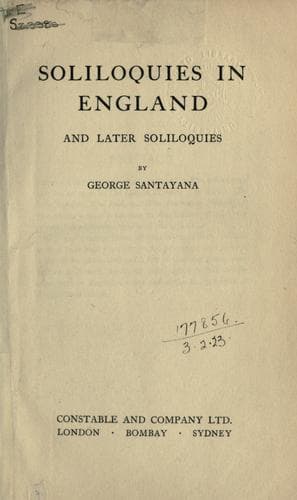
Soliloquies in England, and Later SoliloquiesSantayana, George
Philosophy
Soliloquies in England, and Later Soliloquies
Santayana, George
American essays -- 20th century
On the other hand, in respect to my impersonal opinions, I notice a
little bewilderment, and some obtuseness. Of course, if people are
repelled by the subject or by the manner (which is an integral part
of the thought) and find it all unintelligible, that is no fault of
theirs, nor of mine; but I speak of the initiated and of such as are
willing to lend their minds to my sort of lucubration. For instance,
when more than twenty years ago, I wrote some _Interpretations of
Poetry and Religion_, this is what William James said of them: "What
a perfection of rottenness ... how fantastic a philosophy!--as if
the 'world of values' _were_ independent of existence. It is only as
_being_ that one thing is better than another. The idea of darkness
is as good as that of light, as ideas. There is more value in light's
_being_." William James was a "radical empiricist," so that for him
the being of light could not have meant anything except its being in
idea, in experience. The fantastic view must therefore be some other;
apparently that in the realm of unrealized essences, apart from any
observer, one essence can be better than another. But how could any one
attribute such a view to me? The whole contention of my book was that
the glow of human emotion lent a value to good poetry which it denied
to bad, and to one idea of God which it denied to another. My position
in this matter was that of empirical philosophy, and of William James
himself. In his book on Pragmatism he says that the being of atoms is
just as good as the being of God, if both produce the same effects in
human experience; and I remember once mildly protesting to him on that
point, and asking him if, apart from these effects on us, the existence
of God, assuming God to be conscious, would not have a considerable
value in itself; and he replied, "Of course; but I was thinking of our
_idea_." This was exactly the attitude of my book; I was thinking of
our religious and poetic ideas, and reducing their value to what they
stood for in the elements of our experience, or in our destiny.
Public-domain text, read in full here on John Shaqi.
Reviews
Reviews
No reviews yet
Be the first to share your thoughts on this work.
Elsewhere in the archive
Join the Discussion
Join the discussion
Sign in to leave a comment or review.
Sign InorCreate an account