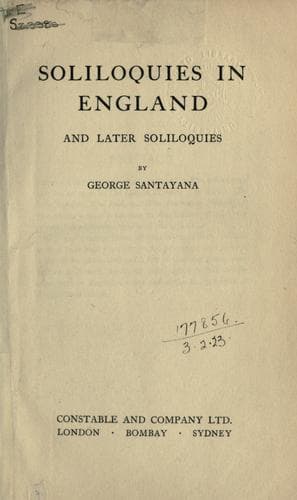
Soliloquies in England, and Later SoliloquiesSantayana, George
Philosophy
Soliloquies in England, and Later Soliloquies
Santayana, George
American essays -- 20th century
will turn its language into a revelation, and its images into idols;
but the abstract character of these symbols will render it easier for
the judicious to preserve the distinction between the things to be
described and the science which describes them.
Was it, I wonder, this touch of sympathy with splendid error, bred in
me by long familiarity with religion and philosophy, that offended my
honest critics? Now that I show less sympathy with it, will they be
better satisfied? I fear the opposite is the case. What they resented
was rather that in spite of all my sympathy, and of all my despair
about science, it never occurred to me to think those errors true,
because they were splendid, except true to the soul. Did they expect
that I should seriously debate whether the Ghost in _Hamlet_ really
came out of Purgatorial fires, and whether Athena really descended
in her chariot from Olympus and pulled Achilles by his yellow hair
when he was in danger of doing something rash? Frankly, I have
assumed--perhaps prematurely--that such questions are settled. I am not
able nor willing to write a system of magic cosmology, nor to propose a
new religion. I merely endeavour to interpret, as sympathetically and
imaginatively as I can, the religion and poetry already familiar to us;
and I interpret them, of course, on their better side, not as childish
science, but as subtle creations of hope, tenderness, and ignorance.
So anxious was I, when younger, to find some rational justification
for poetry and religion, and to show that their magic was significant
of true facts, that I insisted too much, as I now think, on the need
of relevance to fact even in poetry. Not only did I distinguish good
religion from bad by its expression of practical wisdom, and of
the moral discipline that makes for happiness in this world, but I
maintained that the noblest poetry also must express the moral burden
of life and must be rich in wisdom. Age has made me less exacting, and
I can now find quite sufficient perfection in poetry, like that of the
Chinese and Arabians, without much philosophic scope, in mere grace
and feeling and music and cloud-castles and frolic. I assumed formerly
that an idea could have depth and richness only if somehow redolent of
former experiences of an overt kind. I had been taught to assign no
substance to the mind, but to conceive it as a system of successive
ideas, the later ones mingling with a survival of the earlier, and
forming a cumulative experience, like a swelling musical movement.
Now, without ceasing to conceive mental discourse in that way, I have
learned, with the younger generation, to rely more on the substructure,
on the material and psychical machinery that puts this conscious
show on the stage, and pulls the wires. Not that I ever denied or
really doubted that this substructure existed, but that I thought it
a more prudent and critical method in philosophy not to assume it.
Public-domain text, read in full here on John Shaqi.
Reviews
Reviews
No reviews yet
Be the first to share your thoughts on this work.
Elsewhere in the archive
Join the Discussion
Join the discussion
Sign in to leave a comment or review.
Sign InorCreate an account