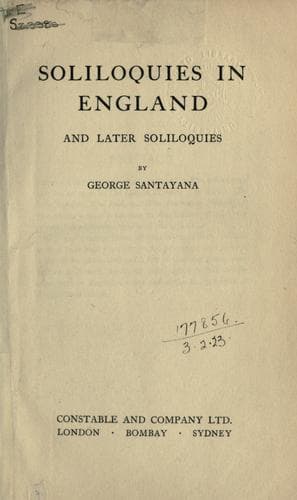
Soliloquies in England, and Later SoliloquiesSantayana, George
Philosophy
Soliloquies in England, and Later Soliloquies
Santayana, George
American essays -- 20th century
Death is the background of life much as empty space is that of the
stars; it is a deeper thing always lying behind, like the black sky
behind the blue. In the realm of existence death is indeed nothing;
only a word for something negative and merely notional--the fact that
each life has limits in time and is absent beyond them. But in the
realm of truth, as things are eternally, life is a little luminous
meteor in an infinite abyss of nothingness, a rocket fired on a dark
night; and to see life, and to value it, from the point of view of
death is to see and to value it truly. The foot of the cross--I dare
not say the cross itself--is a good station from which to survey
existence. In the greatest griefs there is a tragic calm; the fury
of the will is exhausted, and our thoughts rise to another level; as
the shrill delights and the black sorrows of childhood are impossible
in old age. People sometimes make crosses of flowers or of gold; and
I like to see the enamelled crucifix richly surrounded with scrolls,
and encrusted with jewels; without a touch of this pagan instinct the
religion of the cross would not be healthy nor just. In the skirts
of Mount Calvary lies the garden of the resurrection: I do not refer
to any melodramatic resurrection, such as is pictured in Jewish and
Christian legend, but to one which actually followed quietly, sweetly,
in the light of a purer day, in the cloister, in the home, in the
regenerate mind. After renouncing the world, the soul may find the
world more amiable, and may live in it with a smile and a mystic
doubt and one foot in eternity. Vanity is innocent when recognized to
be vain, and is no longer a disgrace to the spirit. The happiness of
wisdom may at first seem autumnal, and the shadow of the cross the
shadow of death; but it is healing slow; and presently, in the hollow
where the cross was set, the scent of violets surprises us, and the
crocuses peep out amongst the thorns. The dark background which death
supplies brings out the tender colours of life in all their purity.
Far be it from me to suggest that existence is the better because
non-existence precedes and follows it; certainly, if man was immortal
his experience could not include tradition, parentage, childhood, love,
nor old age; nevertheless, from the point of view of both bodily and
intellectual instincts immortality would be far better. But since, as
a matter of fact, birth and death actually occur, and our brief career
is surrounded by vacancy, it is far better to live in the light of the
tragic fact, rather than to forget or deny it, and build everything on
a fundamental lie. Death does not say to life that life is nothing,
or does not exist, or is an illusion; that would be wild talk, and
would show that the inspiration we had drawn from death was as little
capable of doing justice to life, as life itself is when mindless, of
discovering death, or learning anything from it. What the environing
Public-domain text, read in full here on John Shaqi.
Reviews
Reviews
No reviews yet
Be the first to share your thoughts on this work.
Elsewhere in the archive
Join the Discussion
Join the discussion
Sign in to leave a comment or review.
Sign InorCreate an account