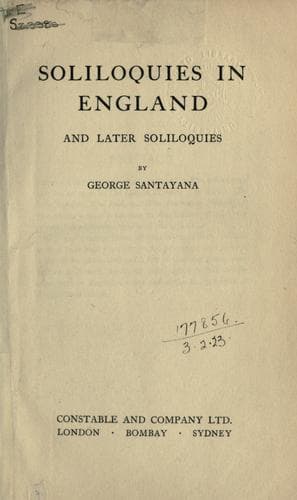
Soliloquies in England, and Later SoliloquiesSantayana, George
Philosophy
Soliloquies in England, and Later Soliloquies
Santayana, George
American essays -- 20th century
Existence, being a perpetual generation, involves aspiration, and
its aspiration envelops it in an atmosphere of light, the joy and
the beauty of being, which is the living heaven; but for the same
reason existence, in its texture, involves a perpetual and a living
hell--the conflict and mutual hatred of its parts, each endeavouring
to devour its neighbour's substance in the vain effort to live for
ever. Now, the greater part of most men's souls dwells in this hell,
and ends there. One of their chief torments is the desire to live
without dying--continual death being a part of the only possible and
happy life. We wish to exist materially, and yet resent the plastic
stress, the very force of material being, which is daily creating and
destroying us. Certainly war is hell, as you, my fair friends, are
fond of repeating; but so is rebellion against war. To live well you
must be victorious. It is with war as with the passion of love, which
is a war of another kind: war at first against the beloved for favour
and possession; war afterwards against the rest of the world for the
beloved's sake. Often love, too, is a torment and shameful; but it
has its laughing triumphs, and the attempt to eliminate it is a worse
torture, and more degrading. When was a coward at peace? Homer, who was
a poet of war, did not disguise its horrors nor its havoc, but he knew
it was the shield of such happiness as is possible on earth. If Hector
had not scoured the plain in his chariot, Paris could not have piped
upon the slopes of Ida, nor sported with his sheep and his goddesses
upon the green. The merchants of Crete or Phoenicia could not have
drawn up their black keels upon the beach, if the high walls of Ilium
had not cast their protecting shadow on their bales of merchandise,
their bags of coin, and their noisy bargaining. When Hector was no more
and the walls were a heap of dust, all the uses of peace vanished also:
ruin and utter meanness came to inhabit that land, and still inhabit
it. Nor is war, which makes peace possible, without occasions in which
a free spirit, not too much attached to existence, may come into its
own. Homer shows us how his heroes could gather even from battle a
certain harvest of tenderness and nobility, and how above their heads,
half seen through the clouds of dust and of pain, flew the winged
chariots of the gods, and music mingled with their banquet.
Public-domain text, read in full here on John Shaqi.
Reviews
Reviews
No reviews yet
Be the first to share your thoughts on this work.
Elsewhere in the archive
Join the Discussion
Join the discussion
Sign in to leave a comment or review.
Sign InorCreate an account