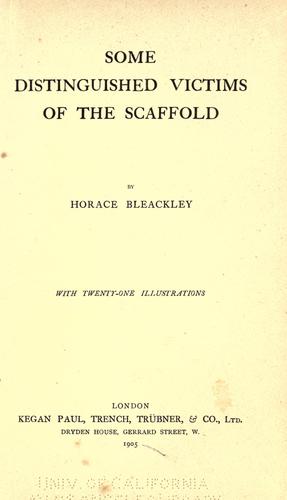
Some Distinguished Victims of the ScaffoldBleackley, Horace
History
Some Distinguished Victims of the Scaffold
Bleackley, Horace
Criminals -- Great Britain; Executions and executioners; Trials -- Great Britain
Friend Nicholson wrote that scandalous reports concerning his honour
had been spread in the neighbourhood since his departure, and that
his wife’s parents had been much disturbed by the rumours that had
reached their ears--informing him also of Colonel Moore’s opinion of
his behaviour. This latter news was superfluous, for there was a letter
from the Irishman himself. Its contents may be gathered from the reply
that the traveller despatched to Nicholson on the 10th of October. With
amazing effrontery he tells his friend that his attentions to the Irish
heiress had never been serious, and expresses his astonishment that
Colonel Moore should censure his conduct. Yet he shows his concern for
the attacks on his integrity, declaring that he will come back at once
to meet his calumniators face to face. Moreover, he was as good as his
word. Probably he left Longtown for Carlisle, according to promise,
the next morning, and arrived at Buttermere on Tuesday, the 12th of
October. Thus Mary’s brief honeymoon came to an end.
As luck would have it, a somewhat remarkable person, who happened to
be acquainted with Colonel Hope, was now staying at Keswick. This was
George Hardinge, senior justice of Brecon, the late Horace Walpole’s
friend and neighbour, the ‘waggish Welsh judge’ of whom Lord Byron
has sung. Having heard of the romantic marriage, and being anxious
to meet Colonel Hope, he sent a letter to Buttermere requesting a
visit. Early on Wednesday morning the newly married man drove over
to Keswick in a carriage and four, accompanied by his factotum, the
Rev. John Nicholson, to answer the summons in person. The meeting,
which took place at the ‘Queen’s Head’ Hotel, was an embarrassing one.
Pertinacious Nathaniel Moore, who no doubt had kindled in Justice
Hardinge’s mind the suspicions which had caused him to solicit the
interview, was present at the encounter. The Welsh judge found that
Colonel Hope of Buttermere renown was an entire stranger to him!
However, the other was in no way abashed, but pointed out pleasantly
that the mistake had arisen through the coincidence of names. Mr
Hardinge persisted that it was remarkable that he should be Alexander
Augustus Hope, M.P. for Linlithgowshire, when the name of the
representative of that county was Alexander Hope. The reply was a
flat denial that these names and titles had been assumed, and we are
told that the credulous clergyman bore witness to the truth of this
statement. Nevertheless, other testimony against the accused man
had more weight with the astute George Hardinge. Not only was there
Colonel Moore’s declaration that the stranger had always passed as Lord
Hopetoun’s brother, but the Keswick postmaster was able to prove that
he had franked letters as a member of Parliament. The result was an
appeal for a warrant of arrest to a neighbouring magistrate, and the
suspected Mr Hope was placed in charge of a constable.
Public-domain text, read in full here on John Shaqi.
Reviews
Reviews
No reviews yet
Be the first to share your thoughts on this work.
Elsewhere in the archive
Join the Discussion
Join the discussion
Sign in to leave a comment or review.
Sign InorCreate an account