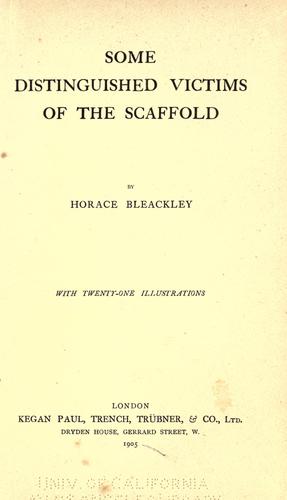
Some Distinguished Victims of the ScaffoldBleackley, Horace
History
Some Distinguished Victims of the Scaffold
Bleackley, Horace
Criminals -- Great Britain; Executions and executioners; Trials -- Great Britain
The King’s Bench Prison, where in 1782 he was confined for a debt
of £160, appears as the next grim landmark in his life. By a lucky
chance he was able to lay his case before the Duke of Rutland, who,
having discovered that the prisoner had married a daughter of his
late uncle, but being ignorant that the wife had died of a broken
heart in consequence of her husband’s desertion, generously paid the
sum necessary to obtain his release. For many years the impostor’s
dexterity in obtaining money under false pretences from credulous
strangers, who believed him to be a connection of the Manners family,
made it possible for him to associate with those far above his rank.
During 1784, after a brief career of fraud in Dublin, where he posed as
a relative of the Viceroy, and by means of this falsehood contracted a
host of fraudulent debts, he was lodged in the Marshalsea Prison. With
unblushing impudence he appealed to the Lord Lieutenant--his previous
benefactor, the Duke of Rutland--who agreed to pay his debts on the
understanding that he should leave Ireland immediately.
In the year 1792 Scarborough became the scene of his depredations.
Staying at one of the principal hotels, he announced his intention of
representing the town in Parliament in the interest of the Manners
family. A portrait of poor Captain Lord Robert caused him to burst into
tears, which evidence of feeling won the sympathy of all who witnessed
it. As usual, his sparkling conversation and distinguished appearance
disarmed suspicion, and for several weeks he lived in princely style at
the expense of his landlord. When pressed for money he did not hesitate
to offer bills of exchange, which the local tradesmen accepted without
demur. Yet the day of reckoning, which this remarkable man never seemed
to anticipate, could not be postponed. On the 25th of April he was
arrested for the hotel debt, and, not being able to find bail, was
cast into prison. Some weeks later, a detainer was lodged against him
by a London creditor, and for eight years he remained an inmate of the
Scarborough Gaol.
During his long confinement he maintained his favourite pose as a
luckless aristocrat, writing poetry, and publishing much abuse against
the authorities. At last fortune smiled upon the interesting captive.
Neither Faublas nor Casanova ruled with more success over the female
heart, and it was to a woman that he owed his release. A Devonshire
lady, named Nation, who, it is said, occupied rooms facing the
prison, took compassion upon him, and paid his debts. On the 13th of
September 1800 the impostor became a free man, and the next morning,
notwithstanding that hitherto they had been strangers, he married his
benefactress. The pair made their home at Hele Bridge, near Dulverton,
on the borders of Somerset and Devon, where the bride’s father was
steward to a neighbouring landowner, and before very long Hadfield
plunged once more into a career of fraud.
Public-domain text, read in full here on John Shaqi.
Reviews
Reviews
No reviews yet
Be the first to share your thoughts on this work.
Elsewhere in the archive
Join the Discussion
Join the discussion
Sign in to leave a comment or review.
Sign InorCreate an account