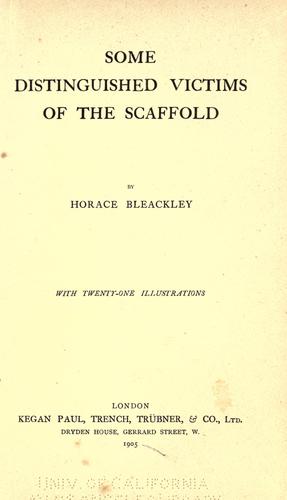
Some Distinguished Victims of the ScaffoldBleackley, Horace
History
Some Distinguished Victims of the Scaffold
Bleackley, Horace
Criminals -- Great Britain; Executions and executioners; Trials -- Great Britain
“Know you?” was the reply. “To be sure I do. Come, be off!”
So the ‘XXX Sheriff’ was forced to make his exit by climbing
ignominiously over seats and benches, to the infinite mirth and
advantage of the gentlemen of the press.
At ten o’clock Justice Park and Baron Garrow come into court, followed
by the Attorney-General, the great Sir John Copley, soon to be Lord
Lyndhurst, who, instructed by Mr Freshfield, solicitor to the bank,
has charge of the prosecution. John Gurney, afterwards a judge, who,
like Scarlett and Adolphus, is one of the great criminal barristers of
his day, defends the prisoner. The buzz of many voices is hushed into
silence as Fauntleroy is placed at the bar. Jaggers Harmer accompanies
him. For a moment he is dazzled by the glare from the inverted mirror
above the dock. Making a feeble attempt to bow to his judges, he almost
falls back into the arms of the attendants. With closed eyes and bent
head, shrinking from the universal gaze, he stands with trembling
fingers resting on the bar--a picture of unutterable shame. Thin and
worn are his features, and his face is pale as death, while his hair,
thrown into contrast by his full suit of black, has become white as
though sprinkled with powder.
The Attorney-General proceeds with the first indictment, that which
charges the prisoner with transferring under a forged deed £5450 Three
per cent. Consols, belonging to Miss Frances Young. During the speech
there comes a disclosure amazing to everyone in court save the man in
the dock and those who defend him. In a private box found at Berners
Street after his arrest, a document has been discovered containing a
list of stolen securities. Upon this paper, written and signed by the
hand of Fauntleroy, and dated the 7th of May 1816, are these words,
which, as Sir John Copley reads them, bewilder all his hearers:--
“In order to keep up the credit of our house I have forged powers of
attorney, and have thereupon sold out all these sums, without the
knowledge of my partners. I have given credit in the accounts for the
interest when it became due. The Bank (of England) began first to
refuse our acceptances, and thereby to destroy the credit of our house;
they shall smart for it.”
Attorney-General and rest of the world are much puzzled, concluding
that but for unaccountable negligence the prisoner would have destroyed
this seemingly incriminating document; as though a forger would not
prefer that his frauds should be thought to have been actuated rather
by devotion to his business and revenge against the unpopular Old Lady
of Threadneedle Street than merely for the sake of self-aggrandisement.
“The Bank of England shall smart for it!” Were the story credible--were
Fauntleroy, in fact, a small defaulter--we may well believe that
another fierce outcry would have arisen against the wicked old harridan
of the City.
Public-domain text, read in full here on John Shaqi.
Reviews
Reviews
No reviews yet
Be the first to share your thoughts on this work.
Elsewhere in the archive
Join the Discussion
Join the discussion
Sign in to leave a comment or review.
Sign InorCreate an account