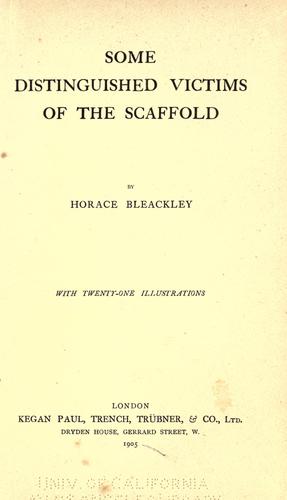
Some Distinguished Victims of the ScaffoldBleackley, Horace
History
Some Distinguished Victims of the Scaffold
Bleackley, Horace
Criminals -- Great Britain; Executions and executioners; Trials -- Great Britain
Gentle Mr Baker, the white-haired layman of the map office in the
Tower, whose work in the foul dungeon was scarcely less admirable
than that of Elizabeth Fry, seems to be more successful in winning
the affections of the condemned man than Ordinary Cotton; and the
efforts of this good Samaritan are aided by a clergyman from Peckham,
named Springett, to whom Fauntleroy had been introduced by a friend.
These two are his constant companions during the remainder of his
imprisonment. Most of his old associates prove loyal, in spite of his
infamy and disgrace, for the fearful penalty of the forger is thought
to atone for the greatest of frauds.
Meanwhile, exertions for a reprieve continue. The condemned banker is
not included in the Recorder’s report on the 20th of November at a
meeting of the Council, over which the King is said to have presided,
and the case is argued twice before the Judges on the 23rd and 24th of
the month. George IV., the only one of the four who was a gentleman,
a scholar, or a man of artistic taste, the only one whose foolish
egotism did not embroil the country in a costly and bloody war, was
also the only one with a merciful heart. His first great fault, for
which neither contemporaries nor posterity have forgiven him, was
infidelity to a dull, silly, uncleanly wife, whom he was compelled to
marry against his will, and who was nothing loth to pay him back in his
own coin. His next, that, like the Duke of Wellington and his brother
William, he was a lion among the ladies. George IV. is inclined to save
Fauntleroy from the scaffold, just as he wished to save all except the
murderer.
Every effort fails, however, and on Wednesday night, after a meeting
of the Privy Council, the Recorder sends his report to Newgate. At
half-past six the Rev. Cotton, whose duty it is to break the news of
their fate to the prisoners, proceeds to Fauntleroy’s room. The banker,
who is reading, looks up as the Ordinary enters, and, observing that he
is deeply affected, “Ah, Mr Cotton, I see how it is,” he exclaims. “I
expected nothing less than death, and, thank God, I am resigned to my
fate.” During the rest of the day he seems more concerned for the doom
of Joseph Harwood--a lad of eighteen, condemned to die the next morning
for stealing half a crown from the pocket of a drunken Irishman--than
for his own dismal situation. Worn out with suspense, he does not awake
until a late hour on Thursday, and thus sleep spares him the anguish of
hearing the awful bell that is added to the torments of those who go to
the scaffold innocent of murder.
Public-domain text, read in full here on John Shaqi.
Reviews
Reviews
No reviews yet
Be the first to share your thoughts on this work.
Elsewhere in the archive
Join the Discussion
Join the discussion
Sign in to leave a comment or review.
Sign InorCreate an account