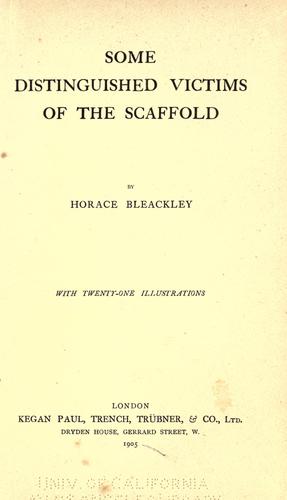
Some Distinguished Victims of the ScaffoldBleackley, Horace
History
Some Distinguished Victims of the Scaffold
Bleackley, Horace
Criminals -- Great Britain; Executions and executioners; Trials -- Great Britain
Although such an escape was a physical impossibility to
Fauntleroy, there is a rational explanation of the strange
superstition--referred to in this book--that he did not die
on the scaffold, but was resuscitated, and lived abroad for
many years. At eight o’clock on the evening of his death the
body was taken by the undertakers, Gale and Barnard, to their
premises opposite Newgate prison, where the coffin was fastened
down immediately by order of the relatives, who had reason
to fear that the morbid--attracted by the notoriety of the
criminal--would seek by means of a bribe to view the remains.
The flames of rumour are set ablaze by a tiny spark, and the
fact that no one outside the prison saw the dead body of the
forger may have revived popular faith in a favourite belief.
The haste, too, in sealing up the shell may have excited
suspicion. For in later days it is certain that many persons
cherished the idea that Fauntleroy, more lucky than Jack
Sheppard or Dr Dodd, whose friends tried in vain to restore
them to life, had survived his execution. _Vide_ also _Notes
and Queries_, First Series, viii. 270, ix. 445, x. 114, 233.
Possibly that prince of inkslingers, G. W. M. Reynolds, may
have had the Fauntleroy legend in his mind when he drew the
picture of the resuscitated forger in the first part of his
obscene and scurrilous romance, _The Mysteries of the Court
of London_. Fauntleroy was buried in the cemetery at Bunhill
Fields on Thursday, Dec. 2.
NOTE IV.--_Old Stories Retold._ By George Walter Thornbury (1867), p.
290.
Public-domain text, read in full here on John Shaqi.
Reviews
Reviews
No reviews yet
Be the first to share your thoughts on this work.
Elsewhere in the archive
Join the Discussion
Join the discussion
Sign in to leave a comment or review.
Sign InorCreate an account