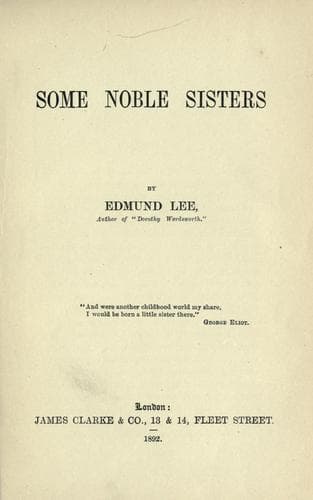
During all the time of periodic distress both Charles and Mary Lamb
were, from time to time, engaged in literary work. In the quiet home,
the most liable among tens of thousands to be at any moment the scene
of heartrending upheaval, we should not have looked for some of the
best work of the age. But such was the case. In the most devoted
brother of the century we have, at the same time, the quaintest
humourist and one of the most subtle critics. And in Mary herself we
have a striking instance of scholastic training being supplemented by
home study and wide reading, until she became an accomplished scholar
and a fit companion to her greater brother. Probably, her love for him
was the great moving cause of Mary's culture. Her own contributions to
literature were of no slight value and interest. Of the twenty
ever-favourite "Tales from Shakespeare," fourteen were written by
Mary, the six tragedies being the production of Charles. The tales are
written with the felicity of style peculiar to the Lambs, and form a
suitable introduction, especially for young people, to the works of
the great dramatist. In a letter by Mary, referring to this joint
production, she says: "Charles has written 'Macbeth,' 'Othello,' 'King
Lear,' and has begun 'Hamlet.' You would like to see us, as we often
sit writing on one table (but not on one cushion, sitting like Hermia
and Helena in the _Midsummer Night's Dream_), or, rather, like an
old literary Darby and Joan--I taking snuff, and he groaning all the
while, and saying he can make nothing of it, which he always says till
he has finished, and then he finds out that he has made something of
it." Mary also wrote a series of entertaining stories for children
under the title of "Mrs. Leicester's School." Nor did she confine
herself to prose. She was the author of several of the pieces in
"Poetry for Children," published in the names of her brother and
herself. It is not certain which of the poems are hers. Apart from
authentic information, of which there is none, opinion is speculative.
Charles stated that his own was about one-third of the whole.
Mary was to her friends a generous correspondent. Her letters show the
same ease and gracefulness of style as the "Tales," and are very
pleasant reading. As a sample one may be given, written to Dorothy
Wordsworth, shortly after the loss of her brother, Captain Wordsworth,
in the _Abergavenny_. This gives us a glimpse of the writer's
sympathetic heart and rare sensibility--
Public-domain text, read in full here on John Shaqi.
Reviews
Reviews
No reviews yet
Be the first to share your thoughts on this work.
Elsewhere in the archive
Join the Discussion
Join the discussion
Sign in to leave a comment or review.
Sign InorCreate an account