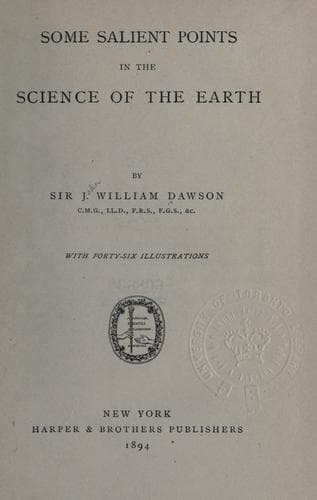
Some Salient Points in the Science of the EarthDawson, John William, Sir
Science
Some Salient Points in the Science of the Earth
Dawson, John William, Sir
Geology; Paleontology
We may here dismiss altogether that form in which these questions
present themselves to the biologist, when he experiments as to the
evolution of living forms from dead liquids or solids attacking the
unsolved problem of spontaneous generation. Nor need we enter on the
vast field of discussion as to modern animals and plants opened up by
Darwin and others. I shall confine myself altogether to that historical
or palæontological aspect in which life presents itself when we study
the fossil remains entombed in the sediments of the earth's crust, and
which will enable me at least to show why some students of fossils
hesitate to give in their adhesion to any of the current notions as to
the origin of species. It will also be desirable to avoid, as far as
possible, the use of the term "evolution," as this has recently been
employed in so many senses, whether of development or causation, as to
have become nearly useless for any scientific purpose; and that when I
speak of creation of species, the term is to be understood not in the
arbitrary sense forced on it by some modern writers, but as indicating
the continuous introduction of new forms of life under definite laws,
but by a power not emanating from within themselves, nor from the
inanimate nature surrounding them.[68]
[68] The terms Derivation, Development and Causation have clear and
definite meanings, and it is preferable, wherever possible, to use one
or other of these.
If we were to follow the guidance of those curious analogies which
present themselves when we consider the growth of the individual
plant or animal from the spore or the ovum, and the development of
vegetable and animal life in geological time--analogies which, however,
it must be borne in mind can have no scientific value whatever,
inasmuch as that similarity of conditions which alone can give force
to reasoning from analogy in matters of science, is wholly wanting--we
should expect to find in the oldest rocks embryonic forms alone, but
of course embryonic forms suited to exist and reproduce themselves
independently.[69]
[69] I may be pardoned for taking an example of the confusion of
thought which this mode of reasoning has introduced into Biology
from a clever article in the _Contemporary_ written by a very able
and much-esteemed biologist. He says: "The morphological distance
between a newly hatched frog's tadpole and the adult frog is almost
as great as that between the adult lancelet and the newly hatched
larvæ of the lamprey." The "morphological distance" truly, but what
of the physiological distance between the young and adult of the same
animal and two adult animals between which is placed the great gulf of
specific and generic diversity which within human experience neither
has been known to pass?
Public-domain text, read in full here on John Shaqi.
Reviews
Reviews
No reviews yet
Be the first to share your thoughts on this work.
Elsewhere in the archive
Join the Discussion
Join the discussion
Sign in to leave a comment or review.
Sign InorCreate an account