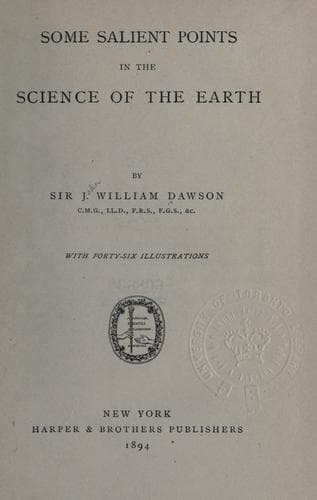
Some Salient Points in the Science of the EarthDawson, John William, Sir
Science
Some Salient Points in the Science of the Earth
Dawson, John William, Sir
Geology; Paleontology
the lighter parts of the crust; and there seems to be little doubt
that both of these principles have been employed in constructing the
"pillars which support the earth." It is evident, however, that an arch
thrown over the internal abyss of the earth, or a portion of its crust
so lightened as to be pressed upward by its heavier surroundings, must,
when once established, have become a permanent feature of the earth's
foundations, not to be disturbed without calamitous consequences to its
inhabitants.
[151] Transactions Royal Society of Canada, 1892.
It is the part of the philosophical naturalist to bring together these
apparent contrarieties of mutation and permanence; both of which are
included, each in its proper place, in the great plan of nature. It is
therefore my purpose in the present chapter to direct attention to some
of the terminal points or fixed arrangements that we meet with in the
course of the geological history, and even in its earlier parts, and
more particularly in reference to the organic world. This, which is in
itself constantly changing, has been placed under necessity to adhere
to certain determinations fixed of old, and which regulate its forms
and possibilities down to our own time.
The argument, as we have seen in a previous chapter, for the animal
nature of Eozoon depends on our assuming certain parts of this fixity.
We suppose that then as now calcium carbonate had been selected as the
material for the skeletons of such creatures; that then, as now, minute
tubuli and large canals were necessary to enable the soft animal matter
to permeate and pass through the skeleton, and that the protoplasmic
animal matter of these far back geological periods had the same vital
properties of contraction and extension, digestion, etc., that it has
to-day. Could any one prove that these determinations of vital and
other forces had not been established, or that living protoplasmic
matter, with all its wonderful properties, had not been constructed in
the Laurentian period, the existence of this ancient animal would be
impossible. Yet how much is implied in all this, and though nothing
is more unstable chemically or vitally than protoplasm, if it were
introduced in the Laurentian, it has continued practically unchanged up
to the present time.
If we pass on to the undoubted and varied life of the Cambrian period,
we shall find that multitudes of things which might have been otherwise
were already settled in a way that has required no change.
Public-domain text, read in full here on John Shaqi.
Reviews
Reviews
No reviews yet
Be the first to share your thoughts on this work.
Elsewhere in the archive
Join the Discussion
Join the discussion
Sign in to leave a comment or review.
Sign InorCreate an account