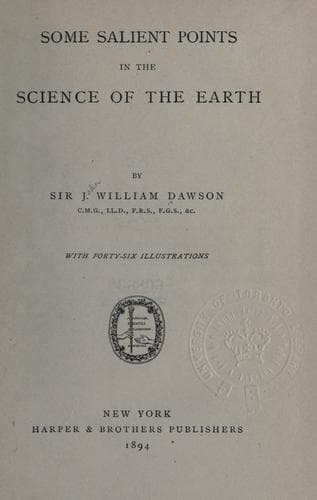
Some Salient Points in the Science of the EarthDawson, John William, Sir
Science
Some Salient Points in the Science of the Earth
Dawson, John William, Sir
Geology; Paleontology
To turn to a later but very ancient period, what can be more
astonishing than those first air-breathing vertebrates of the Coal
formation referred to in a previous chapter, with all their special
arrangements for an aërial habitat? I have mentioned their footprints,
and when we see the quarrymen split open a slab of sandstone and expose
a series of great plantigrade tracks, not unlike those of a human foot,
with the five toes well-developed, we are almost as much astonished as
Crusoe was when he saw the footprints on the sand. Crusoe inferred the
presence of another man in his island; we infer the earliest appearance
of an air-breathing vertebrate and the pre-human determination of the
form and number of parts of the human foot and hand, to appear in the
world long ages afterward. We see also that already that decimal system
of notation which we have founded on the counting of our ten fingers
was settled in the framework of most unmathematical Batrachians. It has
approved itself ever since as the typical and most perfect number of
parts for such organs.
If sceptically inclined, we may ask, Why five rather than four or six?
In the case of man we see that individuals who have lost one finger
have the use of the hand impaired, while the few who happen to have
six do not seem to be the better. How it was with the old Batrachians
we do not know; but it is certain that if we could have amputated the
claw-bearing little toe of _Sauropus unguifer_, or the reflexed little
toe of _Cheirotherium_, we should have much injured their locomotive
power.
The vegetable kingdom is full of similar examples of the early
settlement of great questions. Perhaps nothing is more marvellous
than the power of the green cells of the leaf as workers of those
complex and inimitable chemical changes whereby out of the water,
carbon dioxide and ammonia of the soil and the atmosphere, the living
vegetable cell, with the aid of solar energy, elaborates all the varied
organic compounds produced by the vegetable kingdom. Yet this seems all
to have been settled and perfected in the old Silurian period, long
before any kind of plant now living was on the earth. Perhaps in some
form it existed even in the Laurentian age, and was instrumental in
laying up its great beds of carbon. So all that is essential in plant
reproduction, whether in that simpler form in which a one-celled spore
is the reproductive organ, or in that more complex form in which an
embryo plant is formed in the seed, with a store of nourishment laid up
for its sustenance.
Public-domain text, read in full here on John Shaqi.
Reviews
Reviews
No reviews yet
Be the first to share your thoughts on this work.
Elsewhere in the archive
Join the Discussion
Join the discussion
Sign in to leave a comment or review.
Sign InorCreate an account